

JOIN THE PAWFECT JOURNEY NEWSLETTER
Get our best pet care tips, product picks, and deals sent straight to your inbox. It is free.
Subscribe FreeChoosing the best hamster cage comes down to one number that almost no product listing puts in the title: continuous, unbroken floor space. A cage can be marketed as large, come with eight accessories, and still give your hamster less room than a shoebox lid. The widely used minimum in hamster keeping is 450 square inches of continuous floor space, and the RSPCA housing guidance points to dimensions that work out closer to 620 square inches. Welfare organisations around the world land in that same range.
We measured four hamster cages that are actually in stock right now and did the arithmetic on each one. Only one of the four cleared the minimum: the COZIWOW Hamster Cage Chewproof at 702 square inches of floor for $159.99. The other three are useful for specific jobs, and we say plainly below which ones should never be a hamster’s only home.
Last updated: October 22, 2026
Best Hamster Cage Picks: Floor Space at a Glance
| Cage | Floor dimensions | Floor space | Clears 450 sq in? |
|---|---|---|---|
| COZIWOW Chewproof | 39 in x 18 in | 702 sq in | Yes |
| BESNEW Wooden 24 in | 24 in x 16 in | 384 sq in | No |
| RelinPOE All in 1 | 17.7 in x 11.8 in | 209 sq in | No |
| Cycodo 8 in 1 | 14 in x 10 in | 140 sq in | No |
Shelves, ramps, and second levels do not count toward that number. A hamster runs and forages along the ground, so the figure that matters is the single largest uninterrupted rectangle of floor.
The Cages We Measured, Ranked by Floor Space
1. COZIWOW Hamster Cage Chewproof, 39 in x 18 in x 40 in
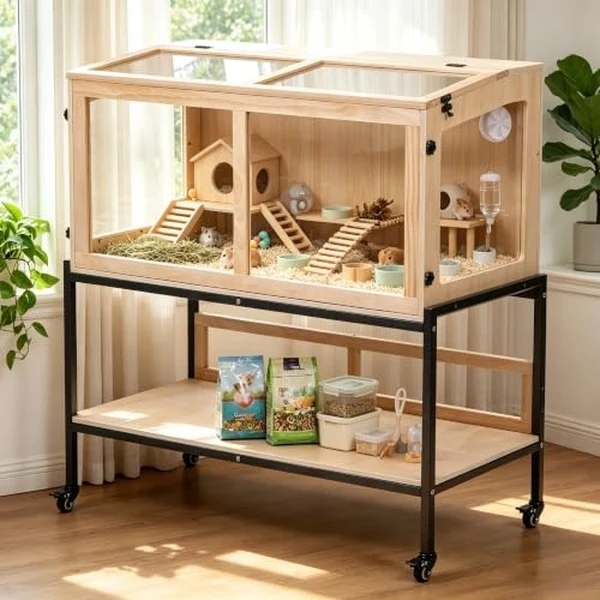
This is the only cage in the group that clears both the 450 square inch minimum and the higher 620 square inch mark, with 702 square inches of continuous floor. The base is wood with acrylic panels rather than wire, the top opens fully for cleaning and scooping a hamster out, and it sits on a wheeled stand with a storage shelf underneath for bedding bags and food.
The height matters as much as the footprint here. A solid-walled base lets you pack in a genuinely deep bedding layer without it spilling out every time your hamster digs, which is the single upgrade most owners notice first.
Who should skip it: at $159.99 and 39 inches wide on a stand, it needs real floor space in your room and a real budget. If you are buying for a child’s desk, this is not it.
RELATED: How Long Do Hamsters Live? Average Lifespan by Breed
2. BESNEW Wooden Hamster Cage, 24 in x 16 in x 16 in
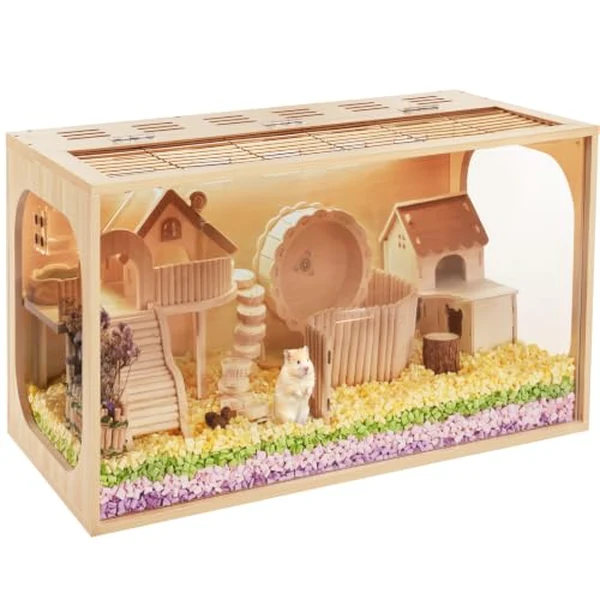
At 384 square inches, this one falls short of the 450 minimum, and we are not going to pretend otherwise. It is the closest of the budget options, though, and the build is the right idea: thickened wood with an acrylic front, multiple vent panels, an openable top, and a leakproof base that holds deep bedding well.
Who it actually suits: a dwarf hamster whose owner adds daily out-of-cage time in a playpen, or anyone who wants a second setup for cleaning days. If this is going to be the only enclosure a Syrian hamster ever lives in, buy bigger instead.
3. RelinPOE All in 1 Hamster Cage with Tunnel, 17.7 in x 11.8 in x 13.4 in
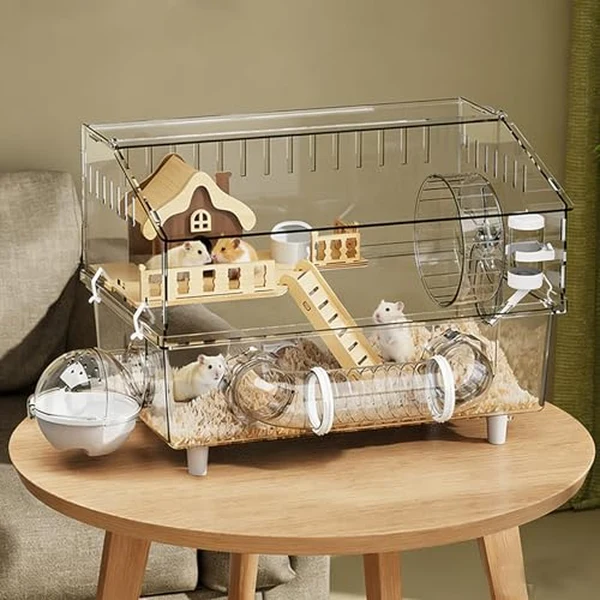
209 square inches. That is less than half the minimum, so treat this as what it really is: a clear-sided starter or transport habitat, not a permanent home. It ships with seven accessories and a tunnel, the acrylic gives you a full view, and it is light enough to carry to the vet or move to a quiet room during a house clean.
Who should skip it: anyone buying a hamster’s main cage. If a shop or a listing tells you this size is enough for a Syrian, that advice is wrong.
4. Cycodo 8 in 1 Acrylic Hamster Cage, 14 in x 10 in x 11 in
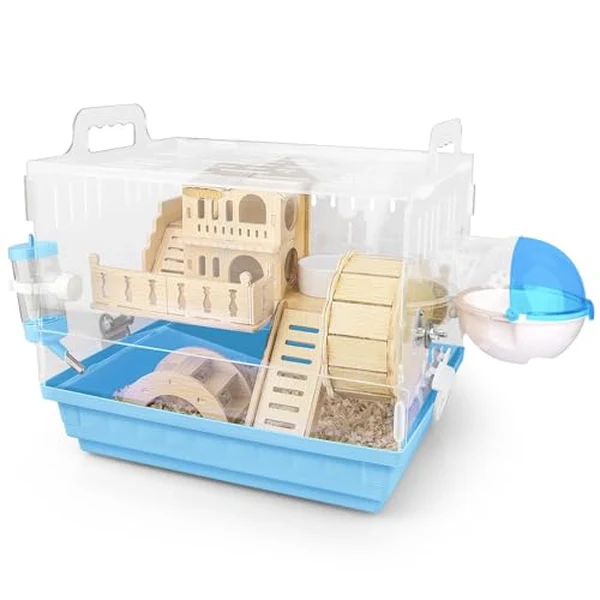
The smallest in the group at 140 square inches, and the cheapest at $39.99. The two-tier layout, wooden wheel, and hideout are nicely made for the money, and nearly 500 buyers rate it well. None of that changes the arithmetic.
Who it actually suits: a travel carrier, a quarantine or recovery box on a vet’s advice, or a temporary holding tub while you deep clean the real enclosure. Not a main cage for any hamster, dwarf included.
What Makes a Hamster Cage Good, Even If It Is Not on This List
Use these six checks on any cage you are considering, including ones we have not measured.
- Continuous floor space first. Multiply the base length by the base width. If the answer is under 450 square inches, no accessory list rescues it. Ignore any “total space including levels” figure in the listing.
- Depth for bedding. Solid walls at least 8 to 10 inches tall let you fill deep without spillage. Wire-sided cages with a shallow plastic tray cannot hold a burrowing layer.
- Bar spacing or solid panels. If the cage has bars, spacing should be no wider than about half an inch for a Syrian and narrower for dwarfs, which slip through gaps adults assume are safe.
- Real ventilation. Fully sealed acrylic boxes trap ammonia. You want a mesh top or generous vent panels, not just a few drilled holes.
- Chew resistance where it counts. Untreated softwood edges get gnawed. Acrylic fronts with wood frames hold up better than thin plastic bases, which hamsters chew through and escape from.
- Top access. A lid that opens fully makes spot cleaning quick and lets you lift a hamster out without reaching through a small side door and startling them.
RELATED: Do Guinea Pigs Like to Be Held? Handling and Bonding Tips
Hamster Cage Safety: What the Cage Alone Will Not Fix

Bedding depth is not optional. Hamsters are burrowing animals, and a shallow scatter of shavings gives them nothing to do. Aim for at least 6 inches throughout with a deeper zone of 10 inches or more where they can build a real tunnel. A big cage with an inch of bedding is still a boring cage.
Wheel size causes real injuries. If your hamster’s back arches while running, the wheel is too small. Dwarfs need roughly 8 inches of diameter and Syrians need 10 to 12 inches. Undersized wheels are linked to lasting spinal curvature, and the damage is often permanent once it sets in. Check the wheel that ships in any kit, because bundled wheels are frequently too small.
One hamster per cage. Syrian hamsters are solitary and will fight, sometimes fatally, if housed together no matter how large the enclosure. Dwarf species are sometimes kept in pairs but often fall out later, and a bigger cage does not make cohabiting safe. Veterinary guidance on hamster housing is consistent on this point.
Ventilation and escapes. Ammonia from urine builds fast in a sealed box, so airflow matters as much as size. And a determined hamster will find any gap, chew any thin plastic corner, and squeeze through a bar spacing you were sure was too narrow. Check the seams every time you clean.
How We Choose Our Picks
Pawfect Journey roundups are research based. We compare each product’s published specs, sizing and materials against what your pet actually needs, and we read verified owner reviews looking for problems that keep coming up. We do not claim hands on lab testing we have not done, and no brand can pay for a spot on our lists. Some links earn us a commission, which never changes the order.
Frequently Asked Questions
What is the minimum size for a hamster cage?
450 square inches of continuous, unbroken floor space is the widely used minimum for both Syrian and dwarf hamsters, with 600 to 800 square inches strongly preferred. Measure the base only. Shelves and second levels do not count toward the total.
Do multi-level cages count toward floor space?
No. Extra levels add enrichment and climbing, which is a bonus, but hamsters run and forage along a single plane. Two 200 square inch levels do not equal one 400 square inch floor, and neither reaches the minimum anyway.
Is a bin cage or an aquarium better than a store-bought cage?
Often yes, on the one metric that matters most. A 40 gallon breeder tank or a large modified storage bin gives you well over 450 square inches for far less than a purpose-built cage. The trade-off is ventilation, so a bin needs mesh panels cut into the lid and sides, and a tank needs a mesh top rather than a glass one.
How deep should hamster bedding be?
At least 6 inches across the enclosure, with a section of 10 inches or deeper for burrowing. Syrians in particular use the extra depth. Paper-based bedding and aspen both work. Avoid cedar and untreated pine shavings, whose oils irritate the respiratory tract.
How often should a hamster cage be cleaned?
Spot clean the toilet corner and any damp bedding every few days, and do a partial change every two to four weeks rather than stripping everything at once. Full teardowns destroy the scent map your hamster has built and can trigger stress behaviours, so always return a handful of used, clean bedding to the fresh layer.
RELATED: 83 Famous Cartoon Hamster Names
The Bottom Line
Of the four cages we measured, only the COZIWOW Hamster Cage Chewproof gives a hamster the floor space welfare guidance actually calls for, at 702 square inches for $159.99. The BESNEW wooden cage is the best of the budget builds but still lands under the minimum, and the RelinPOE and Cycodo habitats are travel and temporary setups rather than permanent homes.
If your budget will not stretch to a large cage yet, put the money into floor space before accessories. A plain enclosure with room to run, a properly sized wheel, and 8 inches of bedding beats a small cage packed with tunnels every single time.
Disclaimer: Some of the links in this article are affiliate links, meaning we may earn a small commission if you make a purchase through them. This comes at no additional cost to you and helps support Pawfect Journey. Thank you for helping us keep the journey going!
Author

Shopping for your pet on Amazon? New members can sign up for a free trial of Prime for fast free shipping and member-only deals, and cancel anytime.
Sign Up for a Free Trial of Prime


