


PRIME BIG DEAL DAYS IS OCTOBER 6 TO 7
Prime members get the sale prices, plus fast free shipping on food, litter, and pet gear. New to Prime? Try it free.
Start Your Free Prime TrialThe best dog harness is not the one with the most features. It is the one that sits off your dog’s throat, does not slide into the armpits, and cannot be reversed out of on a bad day. Get those three things right and almost any decent harness works. Get them wrong and you have bought an expensive collar that also rubs your dog raw.
Across four picks below, the one we would buy first is the Embark No Pull Dog Harness at $32.98, mostly because it is the only harness here with more than ten thousand ratings behind it. If your dog pulls hard, skip to the dual-clip PAWFLOW at $19.99 instead. Here is how the four compare before we get into detail.
| Harness | Best For | Price | Ratings | Buy It If |
|---|---|---|---|---|
| Embark No Pull Reflective Vest | Everyday walking, all sizes | $32.98 | 10,707 | You want the safest bet and will pay for it |
| PAWFLOW 2 Leash Clip Oxford Vest | Dogs that pull | $19.99 | 15 | Your dog drags you and you want a front clip |
| Naibeilerye Mesh Step-In Set | Small dogs and puppies | $18.90 | 17 | Your dog hates things going over its head |
| PetBonus Car Seat Belt Tether | Car travel | $19.99 | 12 | Your dog rides loose in the back seat |
The 4 Best Dog Harness Picks
1. Embark No Pull Dog Harness, Reflective Adjustable Training Vest
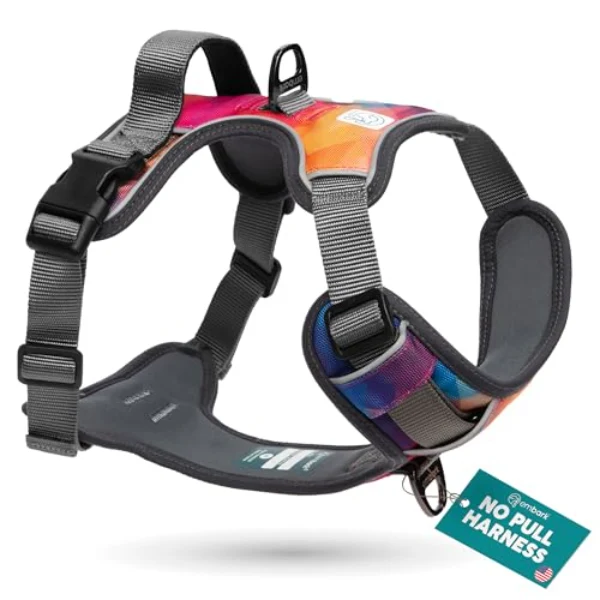
This is the pick with real history behind it. More than 10,000 ratings is not a guarantee of quality, but it does mean thousands of dogs of every shape have worn this harness and the design survived the feedback. It has four adjustment points, a padded chest panel, 360 degree reflective trim for early morning and evening walks, and both a front and a back attachment ring.
- Four adjustment points, so it fits deep-chested and barrel-chested dogs
- Front ring and back ring, so you can use it for training or for casual walks
- 360 degree reflective trim
- No-choke design that loads the chest rather than the throat
The trade-off: at $32.98 it is roughly 65 percent more than the PAWFLOW and nearly double the Naibeilerye. You are paying for the track record, not for a feature the cheaper harnesses lack. If your dog is easy on a leash and does not pull, that premium buys you very little.
$32.98 at AmazonRELATED: How Long Does It Take to Potty Train a Puppy? A Realistic Timeline
2. PAWFLOW No Pull Dog Harness with 2 Leash Clips
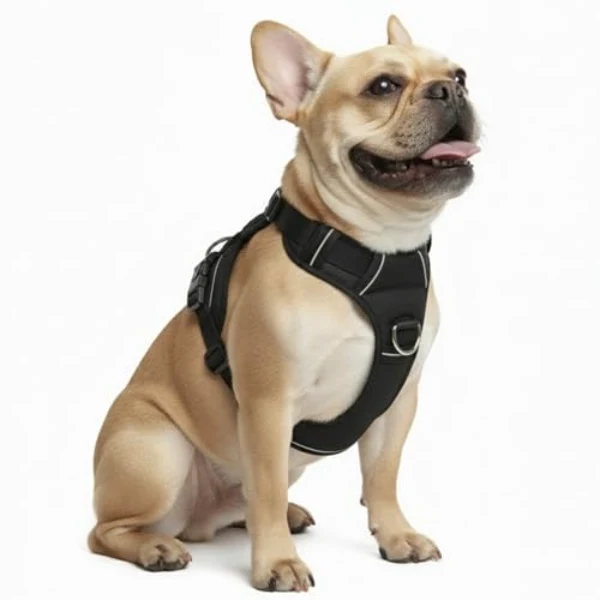
If your dog pulls, the feature that actually changes your walk is a front attachment ring. The American Kennel Club is direct about this: clipping to the front, or better still running a double-ended leash to both the front ring and the ring at the withers, gives you two points of contact and keeps the dog balanced while you work on loose-leash walking. This padded Oxford vest has both rings plus a grab handle across the back.
- Front clip and back clip for two points of contact
- Padded Oxford shell with reflective stitching
- Control handle across the back for road crossings and vet visits
- Cheapest way here to get a genuine front-clip setup
The trade-off: 15 ratings is a thin sample. The specs below are the manufacturer’s claims rather than anything a large body of owners has stress-tested, and PAWFLOW sells this in sizing that runs small, so measure before you order rather than picking by your dog’s weight.
$19.99 at Amazon3. Naibeilerye Breathable Mesh Puppy Harness and Leash Set

Plenty of small dogs and puppies panic when something is pushed over their head. A step-in design solves that: the dog puts two front feet in, you lift and buckle across the back, and nothing ever passes the face. This one is soft mesh, so it breathes in summer, and it ships with a matching padded-handle leash, which is why it lands close to the PAWFLOW on price despite being the simpler product.
- Step-in design, nothing goes over the head
- Breathable mesh for warm weather and thin-coated dogs
- Reflective trim
- Matching leash with a padded handle included
The trade-off: step-in harnesses are back-clip only, so this is the wrong choice for a determined puller. It is also mesh, which is comfortable but will not survive a dog that chews its own gear. Buy it for a calm small dog, not for a 60 pound adolescent.
$18.90 at AmazonRELATED: Best Dog Crate: 5 Picks Sized for Every Dog and Every Room
4. PetBonus Dog Seat Belt for Car
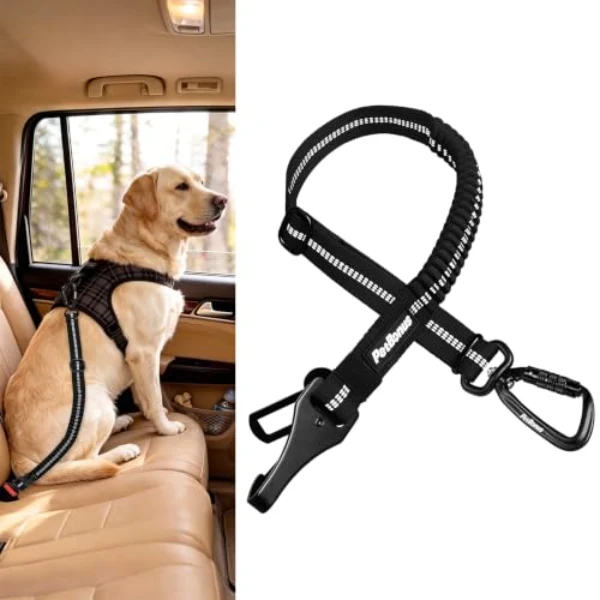
Being straight about what this is: the PetBonus is not a harness. It is the tether that turns the harness your dog already wears into a car restraint, clipping the harness’s back ring to your vehicle’s seat belt receiver. We are including it because a harness in the car without one does nothing at all, and because a leash is genuinely dangerous used this way.
- Clips into a standard seat belt buckle
- Elastic bungee section absorbs the jolt of a hard stop
- Autolocking heavy duty buckle and hook latch
- Adjustable length so the dog can sit or lie down but not reach the front
The trade-off: only 12 ratings, and no bungee tether is crash-tested restraint on its own. Treat this as travel management that stops your dog climbing into your lap, not as a safety device rated for a collision. Never clip one to a collar.
$19.99 at AmazonWhat Makes a Dog Harness Worth Buying
The number printed on the box is the wrong number. Harness sizes are labelled S, M, L and XL, and those letters mean nothing across brands. The spec that decides whether a harness fits is your dog’s girth, measured with a soft tape around the deepest part of the chest just behind the front legs. Measure that, then buy to the girth range on the chart, and ignore the size letter and the weight range entirely. Two dogs at the same weight can be four inches apart at the chest.
Once it is on, the AKC’s fit rules are the ones to test against. Run these four checks before you cut the tags off, because a harness that fails any of them will either hurt your dog or lose your dog.
| Fit Check | What Good Looks Like | Test It Right Now |
|---|---|---|
| Strap tightness | Snug, no pinching when standing or sitting | Slide two fingers flat under every strap. One finger is too tight. Four is an escape |
| Girth strap position | Sitting on the ribcage, not the soft belly | Feel for ribs directly under the strap. If it is on soft stomach, it is too far back |
| Elbow clearance | Nothing pressing into the back of the front legs | Walk the dog ten steps and watch the elbows. Any rubbing means the strap is too far forward |
| Neck opening | Near the top of the sternum, not around the throat | Put two fingers on the strap at the chest. You should feel breastbone, not windpipe |
| Shoulder movement | Front leg reaches forward and out freely | Lift one front paw forward as far as it goes. If the harness stops it, the gait will suffer |
RELATED: Dog Weight Chart: Healthy Weight by Size and Breed
Harness Safety: The Problems That Actually Hurt Dogs
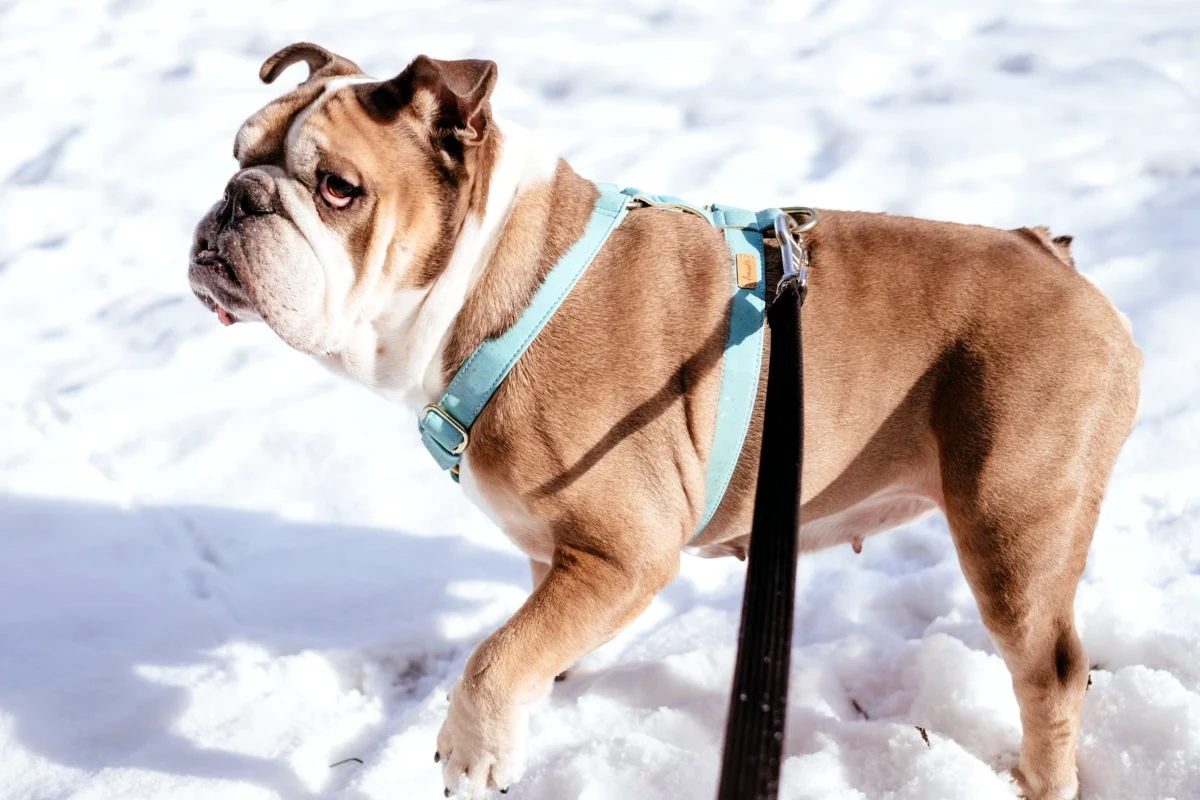
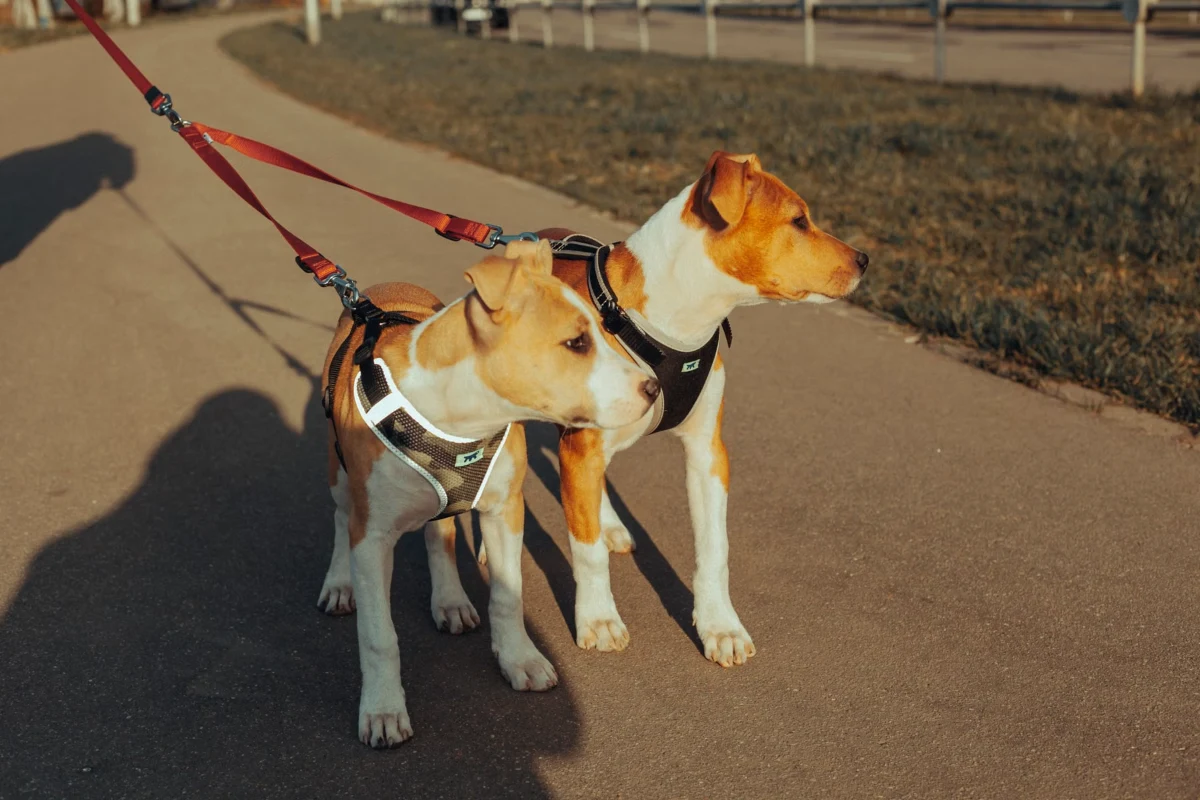
The photo above is what you are aiming for. The front strap crosses the breastbone rather than the throat, the girth strap sits on the ribcage, and the leash loads the back ring rather than the neck. That geometry is the entire reason to own a harness. A harness reduces the risk of neck injuries such as laryngeal paralysis and tracheal collapse by spreading pressure across a larger and less delicate area of the body, which matters most for small breeds, flat-faced dogs, and any dog that hits the end of the leash at speed.
The flip side is worth saying plainly, because most harness articles will not. A badly fitted harness is worse than a plain collar. Canine sports medicine veterinarian Dr. Chris Zink has described poorly fitted harnesses causing overuse soft tissue injuries from abnormal pressure and from the compensatory muscle work of an unnatural gait. Trainers report the same thing from the other end: fur and skin rubbed raw, and dogs that start refusing the harness entirely after being forced into one a few times.
Three more things worth knowing before you buy:
- Escape artists need three points, not two. Broad-necked and narrow-headed dogs back out of two-strap harnesses. A three-point design with a neck, chest and belly strap is what actually holds them.
- Never leave a harness on an unsupervised dog. Straps catch on crate bars, fence gaps and furniture, and a panicking dog cannot free itself.
- Introduce it with food, not force. Reward the dog for sniffing it, then for putting its head near it, then for putting its head in it. Forcing a nervous dog through the neck opening is how you end up with a dog that hides at walk time.
Frequently Asked Questions
Is a harness better than a collar for a dog?
For walking, usually yes. A harness spreads leash pressure across the chest instead of loading the trachea, which matters enormously for small breeds, brachycephalic dogs, and any dog with a history of coughing on leash. A collar is still the right place for ID tags. Most owners should use both: tags on the collar, leash on the harness.
Do no pull harnesses actually stop pulling?
They reduce it, they do not cure it. A front-clip harness turns your dog gently back toward you when it pulls, which removes the forward reward and buys you enough control to train. The training is still the part that fixes the problem. Treat the harness as the tool that makes loose-leash work possible, not as a substitute for it.
How tight should a dog harness be?
Two fingers flat under every strap, tested with the dog both standing and sitting. Tighter than that pinches and rubs. Looser than that and a determined dog will reverse out of it. Re-check the fit monthly on a growing puppy and after any significant weight change in an adult.
What size dog harness do I need?
Measure the girth, which is the circumference of the chest at its deepest point just behind the front legs, and buy to that measurement. Do not buy by weight and do not trust the size letter. If your dog falls between two sizes, size up and tighten down, because most harnesses have far more room to shrink than to grow.
Can a dog wear a harness all day?
It is better not to. Even a well-fitted harness traps heat and moisture against the skin and can rub over long stretches, and an unsupervised dog in a harness can snag a strap. Put it on for walks and car trips, take it off at home.
The Bottom Line
Buy the Embark at $32.98 if you want the option the largest number of owners have already validated. Buy the PAWFLOW at $19.99 if your dog pulls and you want a front clip for half the money. Buy the Naibeilerye at $18.90 for a small dog that hates things going over its head, and add the PetBonus tether at $19.99 if your dog rides in the car. Then measure the girth, run the two-finger test, and watch the elbows on the first walk. That fit check matters more than which of the four you picked.
Disclaimer: Some of the links in this article are affiliate links, meaning we may earn a small commission if you make a purchase through them. This comes at no additional cost to you and helps support Pawfect Journey. Thank you for helping us keep the journey going!
Author

Shopping for your pet on Amazon? New members can sign up for a free trial of Prime for fast free shipping and member-only deals, and cancel anytime.
Sign Up for a Free Trial of Prime


