


PRIME BIG DEAL DAYS IS OCTOBER 6 TO 7
Prime members get the sale prices, plus fast free shipping on food, litter, and pet gear. New to Prime? Try it free.
Start Your Free Prime TrialHow long do betta fish live? A pet betta usually lives 2 to 4 years, and most of the ones that fall short of that do so for reasons the owner can control. In a bare unheated bowl, a betta often does not see its second birthday. In a heated, filtered, cycled tank of five gallons or more, three to five years is routine, and Aquarium Co-Op notes that with healthy genetics, a good start in life, a stable environment and a proper diet, a betta can reach roughly nine years.
That spread is the entire story. Lifespan in this species is less a fixed biological number than a reflection of the box you keep the fish in. Below you will find the typical ranges by setup, the five variables that actually move the needle, and the checks you can run on your own tank in the next ten minutes.
Betta Fish Lifespan by Setup
These are the ranges keepers consistently report, not figures from a controlled study. Treat them as a map of how much time each upgrade tends to buy you.
| Setup | Typical Lifespan | What to Do About It Today |
|---|---|---|
| Unheated bowl or vase under 1 gallon, no filter | 6 months to 1 year | This is the single biggest loss on the list. Move the fish to a heated tank before you change anything else. |
| 2.5 gallon tank, heated, no filter | 1 to 2 years | Add a gentle sponge filter. You are asking water changes to do a filter’s job. |
| 5 gallon tank, heated, filtered, fully cycled | 3 to 5 years | This is the baseline every betta should get. If you are here, focus on diet and stability. |
| 10 gallon planted tank, heated, filtered, cycled | 4 to 6 years | Extra water volume buys you margin for error when life gets busy. |
| Any of the above, plus a fish from a careful breeder | 5 to 9 years | Genetics only pay off after the tank is right. Fix the tank first, then shop for the fish. |
How Long Do Betta Fish Live in a Bowl Versus a Real Tank?
The bowl is the reason bettas have a reputation as short lived fish. Bettas are tropical animals that want water between 78 and 82 degrees Fahrenheit, and a small unheated container sitting in a room that drops to 68 degrees overnight keeps the fish permanently cold. A cold betta eats less, digests poorly, moves less and gets sick more easily. None of that shows up as a dramatic event. It shows up as a fish that quietly dies at fourteen months.
Water volume is the second half of the problem. A betta in a one gallon container is swimming in its own waste within a couple of days, because there is not enough water to dilute anything and no colony of beneficial bacteria to process it. Aquarium Co-Op recommends at least 5 to 10 gallons for exactly this reason: more water means a more stable temperature, slower swings in water chemistry, and longer stretches between cleanings before conditions turn against the fish.
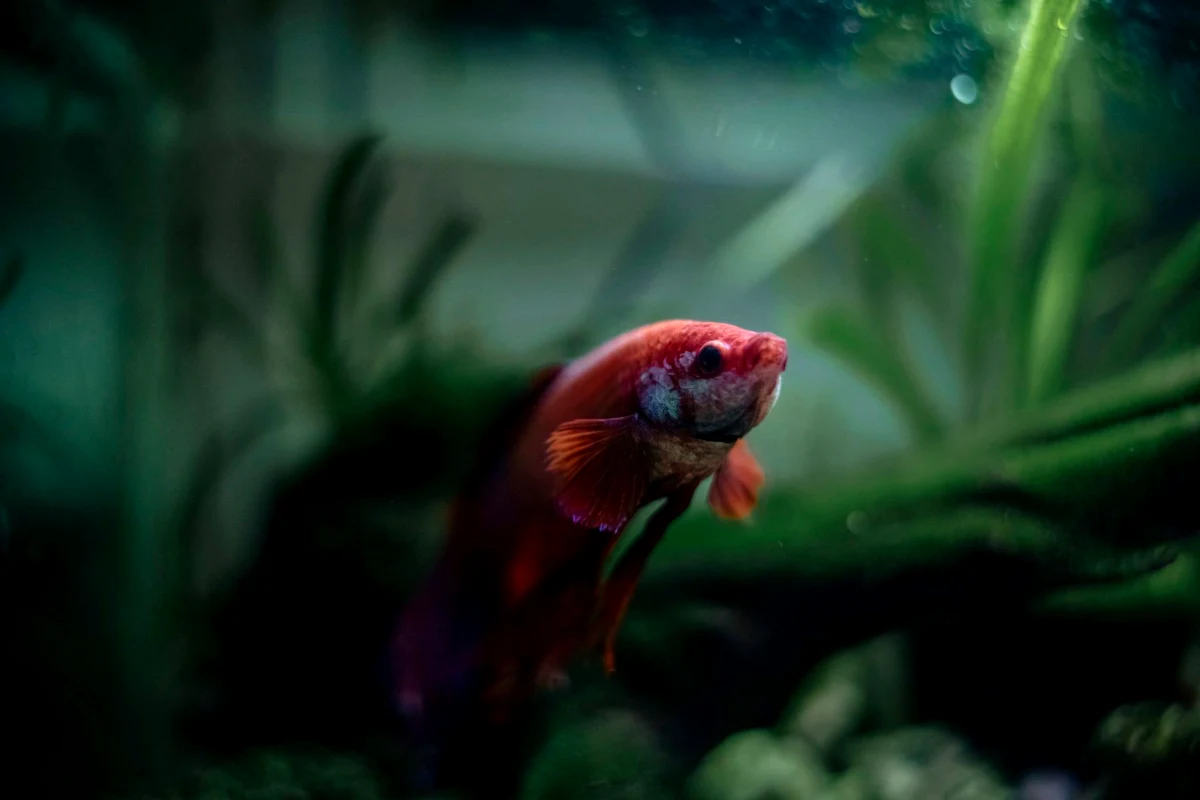
The fish in that photo is in the setup that produces the top half of the table. Nothing exotic is happening. It is warm water, live plants, a filter running quietly, and enough volume that a missed water change is an inconvenience rather than an emergency.
RELATED: Best Aquarium Filter for 20 Gallon Tank: 5 Picks That Actually Fit
Your Betta Was Already an Adult When You Bought It
Here is the part that quietly shortens every betta owner’s math. Bettas are not sold as babies. A male only develops the long fins and saturated color that make him sellable once he has matured, which takes months, so the fish in the cup at the store is already a grown adult. Bettas reach full size at around five months, and store fish are frequently older than that by the time they reach the shelf.
So when someone says their betta lived two years, the fish was very likely closer to three years old. If you buy a betta today and it lives another three years with you, that is a genuinely good outcome, not a disappointment. It also means the clock is already running on day one, which is a good argument for setting the tank up properly before you bring the fish home rather than during its first month.
The Five Levers That Actually Set a Betta’s Lifespan
Almost everything written about betta care collapses into these five variables. The third column is the point: each one has a check you can run today rather than a principle to agree with.
| Lever | What to Aim For | The Test You Can Run Today |
|---|---|---|
| Temperature | 78 to 82 degrees Fahrenheit, held steady | Put a thermometer in the tank and read it at 7 am, before the room warms up. The overnight low is the number that matters, not the afternoon reading. |
| Water volume | 5 gallons minimum, 10 gallons is better | Watch the fish cross the tank. If it gets from one end to the other in two body lengths, the tank is too small. |
| Biological filtration | 0 ppm ammonia and 0 ppm nitrite | Test the water. Anything above 0.2 ppm of either means a partial water change today, not this weekend. |
| Nitrate control | Under 40 ppm | If your test reads 40 ppm or higher, change part of the water now and set a repeating weekly reminder in your phone. |
| Diet | Once a day, only what is eaten in one minute | Time the next feeding. If food is still drifting down after 60 seconds, you are overfeeding and you can stop right there. |
The filtration and nitrate targets come straight from the nitrogen cycle, which is the one piece of aquarium theory worth understanding. Fish waste becomes ammonia, one group of bacteria converts ammonia into nitrite, a second group converts nitrite into far less toxic nitrate, and you remove the nitrate with water changes or live plants. A tank is “cycled” when both bacterial colonies are large enough to consume ammonia and nitrite as fast as the fish produce them. Until that happens, your betta is swimming in a low grade chemical burn, and that is invisible until the damage is done.
Feeding is the lever people get wrong in the most well meaning way. Bettas will beg at the glass, and it is very easy to read that as hunger. Aquarium Co-Op is blunt about it: feed once a day, only as much as the fish clears in about a minute, and do not let the belly become visibly swollen, because constipation and bloating cause real problems in this species. A slightly underfed betta is a common animal. A visibly overfed one is a very common dead one.
RELATED: What Do Goldfish Eat? A Complete Feeding Guide
Do Halfmoons Live Shorter Lives Than Plakats?
This one deserves an honest answer rather than a confident one. There is no solid published lifespan comparison between betta tail types, and anyone quoting you a precise number for how much longer a plakat lives is guessing. What is real is mechanical, not genetic.
The heavily finned varieties in the betta type lineup, halfmoons, rosetails and the more extreme feathertails, are carrying fins that were bred well past anything a wild fish would grow. That fin mass drags. It snags on sharp decor, it tears, and torn fins are an open door for infection. It also means the fish works harder to move, which is why long finned bettas are more often found resting on a leaf partway up the tank. Short finned plakats simply have less to damage.
So the practical translation is not “buy a plakat.” It is that if you own a halfmoon, your decor standards need to be higher. Run your finger over every ornament and any plastic plant before it goes in the tank. If it would catch a stocking, it will catch a fin. Silk or live plants and smooth wood are the fix, and a resting spot near the surface takes real load off the fish.
How to Tell Your Betta Is Getting Old
Aging in bettas is gradual and mostly cosmetic before it becomes functional. The usual signs, roughly in the order they appear:
- Color fades. Deep reds go dusty, iridescent blues lose their metallic edge. This is the earliest and most reliable sign.
- The fins stop fully spreading. An older betta flares less often and less completely, and the fin edges may look slightly ragged even without injury.
- More resting, higher up. Older fish spend more time parked on a broad leaf or a resting hammock near the surface, because the trip up for air costs more than it used to.
- Slower to notice food. Not disinterested, just later to the party. Eyesight declines with age in this species.
- A slight curve to the spine. Common in genuinely old bettas and not treatable, though it can also come from other causes.
One caution that matters more than any of the above. Every single one of these signs can also be an early symptom of illness or poor water quality, and a sick two year old betta looks a lot like an old four year old betta. Before you conclude your fish is simply elderly, test the water. If ammonia, nitrite and temperature all come back where they should be, then age is a reasonable explanation. If they do not, you have found something fixable.
Six Changes That Add Real Time
In rough order of how many months each one tends to buy you:
- Add a heater and a thermometer. Not a heater alone. The thermometer is what tells you the heater is actually working, and a failed heater is silent.
- Get to 5 gallons or more. If you can only make one purchase, this and the heater are the two that change the outcome.
- Run a gentle sponge filter. Bettas cannot fight current with those fins, so an adjustable or low flow filter is the requirement. A filter you had to turn down is better than no filter.
- Cycle the tank before the fish goes in. If the fish is already in an uncycled tank, test daily and change part of the water whenever ammonia or nitrite reads above 0.2 ppm until both hold at zero.
- Feed once a day and stop at one minute. Free, immediate, and it fixes the single most common cause of preventable illness.
- Put a lid on it. Bettas jump, and a fish on the carpet is a lifespan of zero regardless of how good the water was. Covering the aquarium is standard advice for a reason.
RELATED: Fish Names: 220 Ideas for Bettas, Goldfish, and Community Tanks
Frequently Asked Questions
How long do betta fish live in a 5 gallon tank?
Three to five years is the normal outcome in a 5 gallon tank that is heated, filtered and cycled. The tank size alone does not do it. A 5 gallon tank sitting at 70 degrees with no filter will not beat a well run 2.5 gallon, so treat volume, heat and filtration as a package.
What is the oldest a betta fish can get?
There is no official record keeping body for betta longevity, so every number floating around online is a keeper report rather than a verified record. Credible reports cluster in the 7 to 9 year range, and Aquarium Co-Op puts the practical ceiling at about nine years for a fish with good genetics and excellent care from the start. Anything past that is possible but should be treated as an outlier.
Do female bettas live longer than males?
Probably slightly, though the evidence is anecdotal rather than measured. Females have much shorter fins, which means less drag, less fin tearing and fewer infections that start at a torn edge. That is a real mechanical advantage, but it is small compared to whether the tank is heated and cycled. A well kept male will outlive a neglected female every time.
How long do betta fish live without a heater?
It depends entirely on your room, which is why the advice is to measure rather than guess. If the water genuinely holds at 78 degrees or above around the clock, the fish is fine. In most homes it does not, especially overnight and in winter, and a betta living in the low 70s typically loses years. Take the 7 am reading before you decide you do not need a heater.
Can a betta live in a bowl with no filter?
It can survive there for a while, which is exactly why the practice persists. Bettas breathe atmospheric air through a labyrinth organ, so they tolerate low oxygen water that would kill most fish, and people read that tolerance as contentment. Surviving and thriving are different things. A bowl betta is the 6 month to 1 year row in the table at the top of this page.
Does adding tank mates shorten a betta’s life?
It can, in two ways. Fin nipping species like tiger barbs will shred a long finned betta, and torn fins invite infection. And a male betta housed with anything he reads as a rival stays in a low grade state of stress, which suppresses the immune system. If you want a community tank, choose the tank mates around the betta rather than the other way around, and give yourself the volume to separate them if it goes badly.
The Bottom Line
How long do betta fish live comes down to a question you control. Two to four years is the honest average, six months to a year is what a bowl delivers, and three to five years is what a heated, filtered, cycled 5 gallon tank delivers with no other changes. The fish you bought was already an adult, so the clock started before you got involved, which makes the first month of your ownership the most valuable month you have.
If you only do one thing after reading this, put a thermometer in the tank tonight and read it first thing tomorrow morning. It costs almost nothing and it is the fastest way to find out whether your betta is on the top half of that table or the bottom.
Author

Shopping for your pet on Amazon? New members can sign up for a free trial of Prime for fast free shipping and member-only deals, and cancel anytime.
Sign Up for a Free Trial of Prime


