PRIME BIG DEAL DAYS IS OCTOBER 6 TO 7
Prime members get the sale prices, plus fast free shipping on food, litter, and pet gear. New to Prime? Try it free.
Start Your Free Prime TrialFinding the best aquarium filter for a 20 gallon tank is harder than it should be. Twenty gallons sits in an awkward middle ground: most filters are either built for tiny desktop bowls and get overwhelmed, or sized for 55 gallon setups and blast your fish around like a washing machine. Get it wrong and you end up with cloudy water, a noisy motor humming in your living room, or a betta pinned against the glass.
The filters worth buying for this size hit three marks: a flow rate somewhere around 80 to 200 gallons per hour, media you can actually rinse without dismantling the whole unit, and a pump quiet enough that you forget it is running. Our top pick is the AQQA AQ168 Auto Start Hang on Back Filter at $22.49, because it is one of the few filters actually rated for 20 to 30 gallons instead of being stretched to fit.
The 5 Best Aquarium Filters for a 20 Gallon Tank
1. AQQA AQ168 Auto Start Hang on Back Filter (Best Overall)

This is the pick that needs the least justifying. The 6W version pushes 158 GPH and is rated by AQQA for 20 to 30 gallon tanks, which lands almost exactly on the sweet spot for a 20 gallon: roughly eight turnovers an hour, with an adjustable flow knob to dial it back if you keep bettas or fancy guppies.
The auto start feature matters more than it sounds. Most hang on back filters need to be manually re-primed with a cup of water after a power cut or a water change, and if you forget, the pump runs dry. This one refills itself. The media basket slides out from the top, so rinsing the sponge takes about twenty seconds.
Flow: 158 GPH (6W) | Rated for: 20 to 30 gallons | Type: Hang on back
$22.49 at AmazonRELATED: How Often Should You Feed Your Betta Fish?
2. fishkeeper 4-in-1 Multifunction Power Filter (Best Budget)

At $19.99 this is the cheapest filter here, and it is an internal unit rather than a hang on back, which makes it a good choice if your tank sits flush against a wall or has a tight-fitting hood. It handles up to 320 GPH at full tilt across a 20 to 100 gallon range, so on a 20 gallon you will want to run it well below maximum.
The four functions are filtration, oxygenation, circulation, and a wavemaker mode. In practice the bubbler and wavemaker settings are genuinely useful for planted tanks, though they add surface agitation that betta keepers should turn down. Being submerged, it is close to silent from outside the glass.
Flow: up to 320 GPH, adjustable | Rated for: 20 to 100 gallons | Type: Internal
$19.99 at Amazon3. Digoos Electric Sponge Filter (Best for Betta, Shrimp, and Fry)
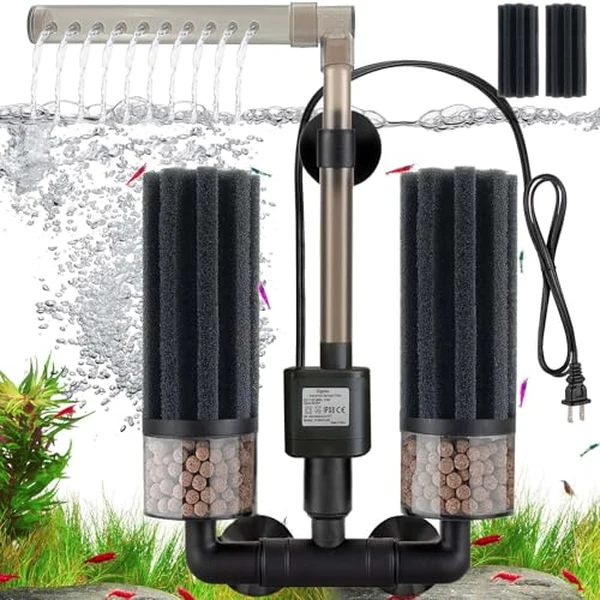
If your 20 gallon houses a betta, a shrimp colony, or fry, a sponge filter is the correct answer and the other four filters on this list are the wrong one. Intake slots on a powered filter will pull in baby shrimp and shred long fins. A sponge draws water gently across a large surface with no impeller anywhere near your livestock.
The trade-off is honest: sponge filters give you biological and mechanical filtration but no chemical stage, so you cannot run carbon to pull out tannins or medication residue. The upside is that the sponge itself becomes a massive bacteria colony, and it is close to impossible to crash the tank by cleaning it.
Flow: gentle, low current | Best for: betta, shrimp, fry, nano stock | Type: Sponge
$29.78 at AmazonRELATED: How Do Betta Fish Sleep?
4. DEGGOX UV Hang on Back Filter (Best for Green Water)
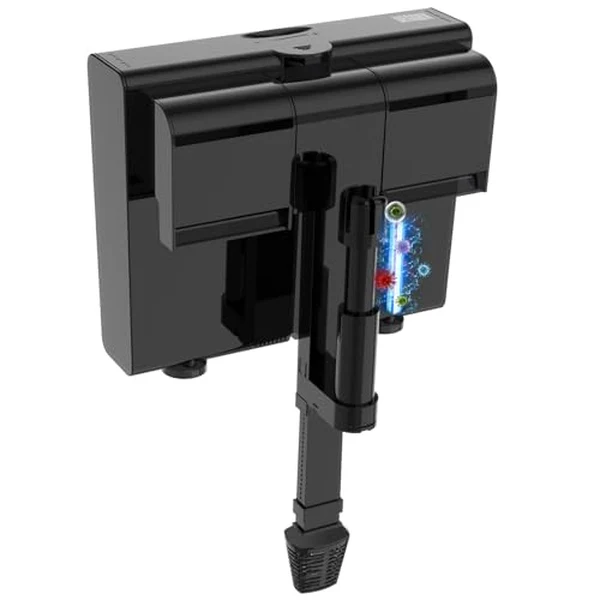
Buy this one for a specific problem: persistent green water. The built-in UV clarifier kills the free-floating algae that turns a tank into pea soup, which no amount of mechanical filtration will fix on its own. It also has a surface skimmer, useful if you get an oily protein film on top of the water.
Be aware that DEGGOX rates this for 30 to 45 gallon tanks at 170 GPH, so on a 20 gallon it is oversized. That is fine as long as you use the flow adjustment and keep an eye on your fish, but if you have long-finned species and no algae problem, pick one of the first three instead. Do not buy a UV filter you do not need.
Flow: 170 GPH | Rated for: 30 to 45 gallons | Type: Hang on back with UV
$39.99 at Amazon5. fishkeeper 264GPH Canister Filter (Best for Heavily Stocked Tanks)

A canister filter on a 20 gallon is overkill for most people, and at $71.99 this is by far the priciest option here. It earns its place for one situation: a heavily stocked tank, a messy eater like a goldfish or a small pleco, or a keeper who does not want to touch the filter for months at a time.
Everything lives in a sealed bucket under the stand, so the tank itself stays clear of equipment and the noise is out of the room. Three stages of media give you far more biological capacity than a hang on back, and it is rated for tanks up to 35 gallons, which means a 20 gallon is comfortably within range rather than at the limit.
Flow: 264 GPH | Rated for: up to 35 gallons | Type: External canister
$71.99 at AmazonWhat Makes a Filter Right for a 20 Gallon Tank
If none of the five above suit your setup, here is how to judge any filter you come across.
Match the flow rate, do not maximize it. The standard guidance is to turn over your tank volume four to six times per hour, which for a 20 gallon works out to roughly 80 to 120 GPH. Filters are usually rated optimistically, and adding media slows them down, so a unit rated 150 to 200 GPH is a sensible real-world target. Anything advertising 400 GPH on a 20 gallon is a current problem waiting to happen.
Check the rated tank range, not just the GPH. A filter sold for 20 to 30 gallons has an intake and media volume designed around that size. A filter stretched down from a 55 gallon rating often has an oversized intake that is harder to guard and a footprint that does not fit a smaller rim.
Look for adjustable flow. This single feature solves most mismatches. A flow knob lets you run the same filter hard on a stocked community tank and gentle on a betta tank.
Ask how you get to the media. You will be rinsing the sponge every few weeks for years. A top-loading basket is a twenty second job. A unit that has to be unmounted and drained is a chore you will start skipping.
Ignore the noise claims and read the reviews. Every filter is marketed as silent. The real complaints show up in reviews after a few months, usually as impeller rattle. Sponge and canister filters are reliably the quietest.
RELATED: What Do Goldfish Eat? A Complete Feeding Guide
Filter Mistakes That Actually Kill Fish
A filter is life support, and the most common ways people harm their fish with one are all avoidable.
Never rinse filter media in tap water. This is the big one. The beneficial bacteria that convert ammonia to nitrite and nitrite to nitrate live in your filter media, and the chlorine in tap water kills them on contact. Rinse the sponge in a bucket of water you just siphoned out of the tank instead. Replacing a cartridge entirely does the same damage, which is why the disposable-cartridge business model is worth avoiding.
Do not run a new filter on a new tank and add fish the same day. A brand new filter has no bacterial colony. The nitrogen cycle takes anywhere from two weeks to two months to establish, and stocking before it does is what people mean by new tank syndrome: ammonia spikes, burned gills, and dead fish in week one.
Watch the current with long-finned fish. Bettas, fancy guppies, and fancy goldfish are poor swimmers. A turnover rate meant for a community tank leaves them exhausted, hiding, or pinned to the glass. Two to three turnovers per hour is plenty for them. If your filter has no flow control, a baffle made from a cut plastic bottle over the outflow works.
Guard the intake if you keep fry or shrimp. An unguarded intake will pull in baby shrimp and small fry. A pre-filter sponge slipped over the intake tube costs a couple of dollars and prevents it.
Do not switch off the filter overnight to quiet it. Your bacteria colony needs oxygenated water moving through it constantly and begins dying off within hours. If the noise is unbearable, fix the cause or change the filter.
Frequently Asked Questions
What size filter do I need for a 20 gallon tank?
Aim for a filter rated between roughly 80 and 200 GPH. The classic rule is four to six times your tank volume per hour, and since manufacturer ratings are measured without media in the way, choosing something near the top of that band gives you real-world headroom.
Can one filter be too powerful for a 20 gallon tank?
Yes. Excess flow will not harm your water quality, but it will stress fish that are not built for current. Long-finned species struggle first. Look for visible signs like a fish being pushed around, hiding constantly, or unable to hold position while resting, and dial the flow down or add a baffle.
How often should I clean a 20 gallon aquarium filter?
Rinse the mechanical sponge every two to four weeks, or whenever you notice the flow slowing. Always rinse in old tank water. Leave the biological media alone unless it is visibly clogged, and never replace all your media at once.
Hang on back, sponge, or canister for a 20 gallon?
A hang on back filter suits most 20 gallon community tanks and is the easiest to maintain. A sponge filter is better for bettas, shrimp, and fry. A canister is worth it only for heavy stocking or if you want equipment out of sight and less frequent maintenance.
Do I need a filter if my 20 gallon tank is heavily planted?
In almost all cases yes. Plants consume nitrate and some ammonia, but they do not provide the water movement or the concentrated bacterial surface area a filter does. Very heavily planted, lightly stocked tanks can run on a simple sponge filter, but going with no filtration at all is a gamble.
The Bottom Line
For most 20 gallon tanks, the AQQA AQ168 at $22.49 is the filter to buy: it is rated for exactly this size, the flow adjusts, and it re-primes itself. Keeping a betta or shrimp instead? Go with the Digoos sponge filter and skip the current entirely. Fighting green water? The DEGGOX UV unit is the only one here that solves that problem.
Whichever you choose, the filter matters far less than how you treat it. Rinse the media in tank water, let the tank cycle before you stock it, and match the flow to the fish you actually keep.
Disclaimer: Some of the links in this article are affiliate links, meaning we may earn a small commission if you make a purchase through them. This comes at no additional cost to you and helps support Pawfect Journey. Thank you for helping us keep the journey going!
Author

Shopping for your pet on Amazon? New members can sign up for a free trial of Prime for fast free shipping and member-only deals, and cancel anytime.
Sign Up for a Free Trial of Prime