


PRIME BIG DEAL DAYS IS OCTOBER 6 TO 7
Prime members get the sale prices, plus fast free shipping on food, litter, and pet gear. New to Prime? Try it free.
Start Your Free Prime TrialSo what do parrots eat? In a home, a healthy pet parrot eats a diet built on formulated pellets, roughly 60 to 80 percent of what goes in the bowl each day, with fresh vegetables and leafy greens making up most of the rest, a little fruit a few times a week, and seeds and nuts kept back as treats. That single sentence is the answer most owners are looking for, and it is very close to the opposite of what a bag labeled “parrot food” on a pet store shelf usually contains.
The gap matters. Seed mixes are highly palatable and birds love them, but they are nutritionally incomplete, high in fat, and short on vitamin A, calcium, and protein, which is why veterinary nutrition guidance for Amazon parrots treats an all-seed diet as a health problem rather than a starting point. Below is what the daily bowl should actually look like, how much to give by parrot size, and how to move a seed-addicted bird onto something better without starving it.
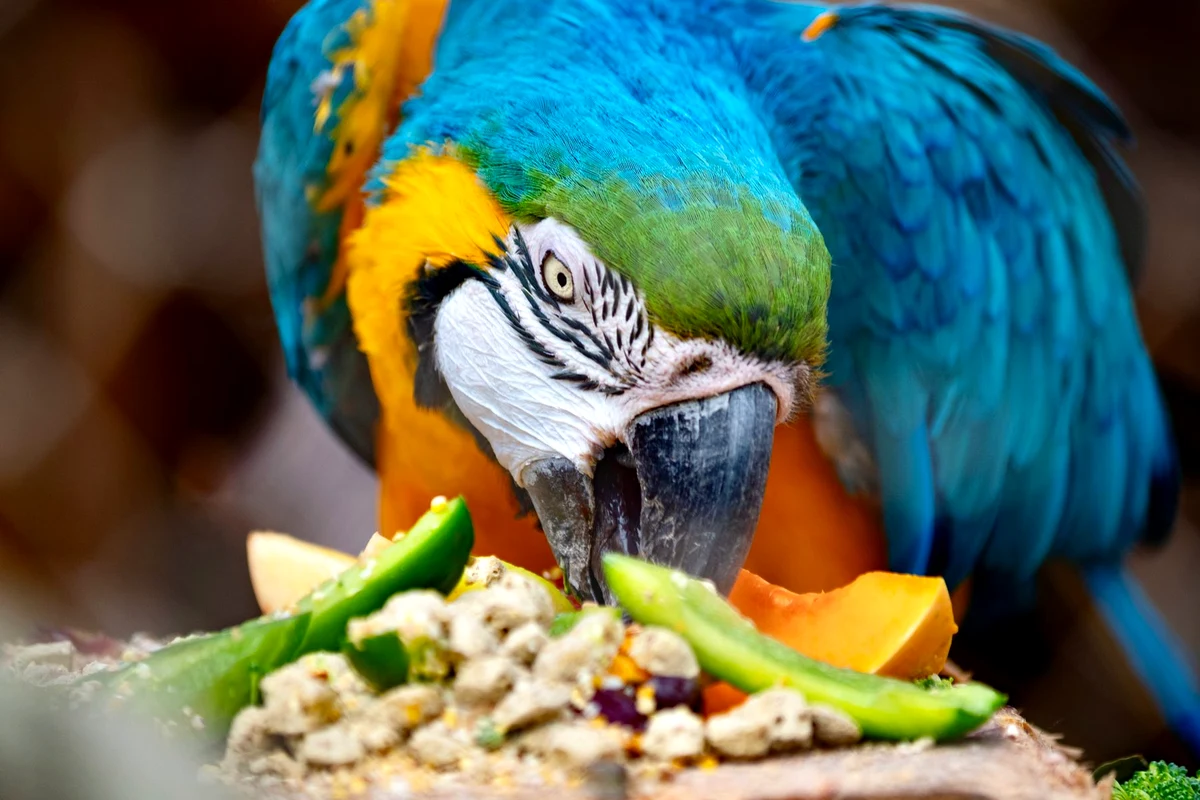
What Parrots Eat: The Daily Diet at a Glance
Use this as the shape of a single day of food. The percentages are by volume of what your bird actually consumes, not by how many bowls you put out.
| Food group | Share of the daily diet | How often | What it looks like in the bowl |
|---|---|---|---|
| Formulated pellets | 60 to 80 percent | Every day, available all day | The base bowl, refilled each morning |
| Vegetables and leafy greens | 20 to 30 percent | Every day | Chopped kale, broccoli, carrot, sweet potato, peppers |
| Fruit | 5 to 10 percent | A few times a week | Two or three small pieces mixed into the chop |
| Seeds and nuts | Under 5 percent | Training and foraging treats only | One almond or a pinch of seed, handed over, not poured |
| Chocolate, avocado, salty or sugary human food | 0 percent | Never | Not in the bowl and not off your plate |
One honest caveat before you print that out. There is no single parrot diet, because “parrot” covers more than 350 species with genuinely different biology. Lories and lorikeets are nectar feeders and need a commercial nectar or wet powder diet, not pellets. Hyacinth macaws are one of the few parrots that genuinely need a high-fat, palm-nut-heavy diet. The table above fits the birds most people actually keep, which is budgies, cockatiels, conures, Quakers, Senegals, African greys, Amazons, cockatoos, and the larger macaws.
RELATED: What Do Parakeets Eat? A Complete Feeding Guide
Pellets: The Base of Everything
A formulated pellet is exactly what it sounds like, a complete diet ground, blended, and baked so your bird cannot pick out its favorite bit and leave the vitamins behind. That last part is the whole point. The most common failure in seed feeding is not that seed is poison, it is that a bird offered a mixed bowl will eat only the sunflower seeds and peanuts and ignore everything else, which is precisely the behavior VCA describes in conures.
Pellets go out every morning when your bird is hungriest and stay available through the day. Parrots are not once-a-day eaters. They graze, and a healthy parrot has a fast metabolism that expects calories coming in steadily rather than in two big meals, which is a point Lafeber makes in its avian diet guide. Foraging formats like nutritionally complete berries or cakes count as pellets for this purpose and have the advantage of taking real work to eat.
Vegetables and Greens: The Part Owners Skip
Vegetables are where a good parrot diet separates itself from an adequate one. Dark leafy greens and orange vegetables carry the beta carotene that becomes vitamin A, and vitamin A deficiency is one of the most common nutrition problems avian vets see in pet parrots. Chop them small, offer them fresh in a separate dish, and take the dish out after a few hours so nothing spoils.
Reliable everyday choices:
- Dark leafy greens: kale, collard greens, dandelion greens, romaine, swiss chard
- Orange and red vegetables: carrot, sweet potato, butternut squash, red and orange bell pepper
- Cruciferous vegetables: broccoli florets, cauliflower, cabbage
- Legumes and grains: cooked beans, cooked quinoa, sprouted lentils, thawed peas and corn
- Herbs: cilantro, parsley, basil, mint
Iceberg lettuce is not harmful, it just is not worth the bowl space, since it is mostly water with very little to offer. Spinach and swiss chard are fine in rotation but should not be the daily green, because their oxalates bind calcium and calcium is already a weak point in most captive parrot diets, particularly for African greys.
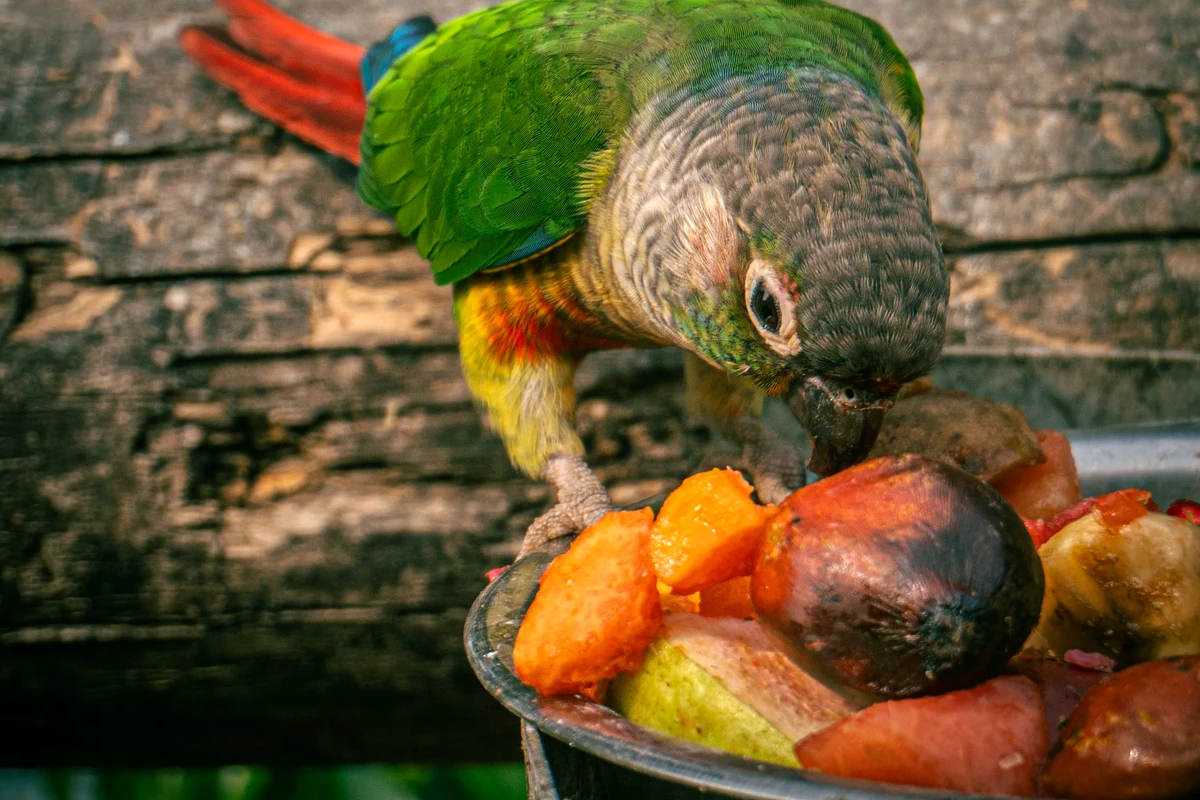
The photo above is what the fresh portion should look like in practice: cut small enough that a bird can pick up a piece in one foot, served in its own dish, and varied enough that no single item dominates.
Fruit: A Smaller Role Than Most People Think
Fruit is safe and parrots love it, which is exactly the problem. It is high in sugar and low in the minerals a captive parrot is usually short on, so it belongs in the diet as a garnish rather than a food group. Apple, banana, berries, melon, mango, papaya, orange, pear, and grapes are all fine in small amounts. Remove apple seeds and the pits of cherries, peaches, plums, and apricots, which contain cyanogenic compounds.
A practical rule: if you can see the fruit from across the room when you look at the bowl, there is too much of it.
RELATED: Can Birds Eat Pumpkin Seeds? What Is Safe and How to Serve Them
Seeds and Nuts: Treats With a Job
Seeds and nuts are not banned, they are demoted. Used as training rewards and foraging payoffs, they are one of the most useful tools you have, because a parrot will work surprisingly hard for a single sunflower seed. Poured into a bowl by the cupful, the same food is the leading cause of obesity and fatty liver disease in pet parrots.
The practical distinction is delivery. If the seed comes out of your hand in exchange for stepping up, going into the carrier, or solving a foraging toy, it is doing its job. If it is sitting in an open dish, it is a diet.
Foods That Are Never Safe
These are worth memorizing rather than looking up in the moment:
- Avocado, including guacamole. All parts of the plant contain persin, which Lafeber notes is a cardiac toxin in birds, and small birds are the most susceptible
- Chocolate, because of theobromine and caffeine. Darker chocolate is worse
- Caffeine in coffee, tea, and soda
- Alcohol in any amount
- Onion and garlic, raw, cooked, or powdered
- Salty and sugary human snacks: chips, crackers, candy, sweetened cereal
- Fruit pits and apple seeds
- Anything you have chewed, since human saliva carries bacteria a bird cannot handle
One non-food hazard belongs on the same list because it kills more parrots than most of the items above: overheated non-stick cookware. The fumes are rapidly fatal to birds, and no amount of careful feeding compensates for a pan left on high in the next room.
How Much Do Parrots Eat? Daily Amounts by Size
Treat these as starting portions, not prescriptions. The only number that tells you whether you got it right is your bird’s weight, so the last column converts the standard “5 percent drift” guideline into actual grams for each size of bird. Weigh weekly on a gram scale, at the same time of day, and take any drift past that number to an avian vet rather than adjusting on your own.
| Parrot | Typical adult weight | Pellets per day | Fresh chop per day | Weekly weight change that means call the vet |
|---|---|---|---|---|
| Budgie or parakeet | 30 to 40 g | 1.5 to 2 tsp | 1 to 2 tsp | About 2 g |
| Cockatiel | 80 to 100 g | 1 to 2 tbsp | 1 tbsp | About 4 g |
| Green cheek conure | 60 to 80 g | 1 to 2 tbsp | 1 tbsp | About 3 g |
| Quaker or Senegal | 100 to 150 g | 2 to 3 tbsp | 1 to 2 tbsp | About 6 g |
| African grey | 400 to 550 g | 1/4 to 1/3 cup | 1/4 cup | About 25 g |
| Amazon parrot | 350 to 550 g | 1/4 to 1/3 cup | 1/4 cup | About 22 g |
| Blue and gold macaw | 900 to 1,300 g | 1/2 to 3/4 cup | 1/2 cup | About 55 g |
If the pellet bowl is still nearly full at bedtime every night, you are offering more than the bird wants and the excess is just going stale. If it empties by mid-morning and your bird spends the afternoon screaming at the empty dish, increase it. Neither of those is a crisis, they are just feedback.
RELATED: Cockatiel Names: 165 Ideas for Males, Females, and Bonded Pairs
How to Switch a Seed-Addicted Parrot to Pellets
Most people reading this already have a bird eating the wrong thing, and the honest news is that the conversion is the hard part, not the knowledge. Parrots are neophobic about food, and a bird that has eaten sunflower seeds for eight years may not recognize a pellet as food at all.
What works, drawn from Lafeber’s conversion case studies:
- Go gradual. Mix a small proportion of pellets into the seed and shift the ratio over weeks, not days
- Offer pellets first thing in the morning, when the bird is hungriest, and hold the seed back until later
- Eat in front of your bird. Parrots are intensely social eaters and will try something they watch you enjoy
- Try warm, damp, or crumbled pellets. Texture is often the objection, not taste
- Weigh daily during the switch. A bird that drops weight is not converting, it is starving, and needs seed back immediately
Never starve a parrot into a new diet. Small birds have very little reserve and can go downhill in a day or two. If your bird has not touched pellets after several weeks of patient work, that is a conversation for an avian vet, not a reason to push harder.
Frequently Asked Questions
Can parrots eat only pellets?
They can survive on pellets alone, and a pellet-only diet is far better than a seed-only diet. But fresh vegetables add variety, enrichment, and hydration, and the act of eating a chopped mix gives a smart bird something to do. Pellets plus fresh produce beats pellets alone.
What human food can parrots eat?
Plain cooked grains and beans, unseasoned cooked pasta, unsalted whole grain toast, cooked sweet potato, and plain scrambled or hard boiled egg are all fine in small amounts. The disqualifier is almost always seasoning. Salt, butter, oil, onion, and garlic are what make table food unsafe, not the food itself.
How often should I feed my parrot?
Pellets stay out all day and get refreshed each morning. Fresh chop goes out once or twice a day and comes back out of the cage after two to four hours so it does not spoil. Parrots graze rather than eating meals, so an empty cage all afternoon is not how the diet should work.
Do parrots need grit?
No. Parrots shell their seeds before swallowing and do not need grit the way pigeons and doves do. Offering it can cause crop impaction, so skip it unless an avian vet specifically prescribes it.
What about vitamin supplements?
A bird eating a quality pellet diet does not need added vitamins, and over-supplementing fat soluble vitamins like A and D can do real harm. Supplements belong in the plan only when a vet has identified a specific deficiency, usually in a bird still eating mostly seed.
Can parrots drink anything other than water?
Fresh clean water, changed daily and more often if food gets dunked in it, is all a parrot needs. Milk is a poor idea since birds do not digest lactose, and juice adds sugar without adding anything useful.
The Bottom Line
What parrots eat in a well run home is straightforward: a quality formulated pellet as the base, a generous daily serving of chopped vegetables and greens, a little fruit, and seeds and nuts reserved for training. The hard part is never learning the rule, it is converting a bird that has already learned to love the wrong bowl. Go slowly, weigh often, and let the scale tell you whether it is working.
Author

Shopping for your pet on Amazon? New members can sign up for a free trial of Prime for fast free shipping and member-only deals, and cancel anytime.
Sign Up for a Free Trial of Prime


