PRIME BIG DEAL DAYS IS OCTOBER 6 TO 7
Prime members get the sale prices, plus fast free shipping on food, litter, and pet gear. New to Prime? Try it free.
Start Your Free Prime TrialWhy do dogs lick you? Most of the time it is a mix of three things: an inherited greeting your dog was born knowing, the taste of salt on your skin, and the simple fact that licking you has always gotten a reaction. Affection is part of it, but it is rarely the whole story, and the honest answer is more interesting than the greeting card version.
The table below decodes the most common licks by where and when they happen, so you can tell a hello from a habit from a health problem in about ten seconds.
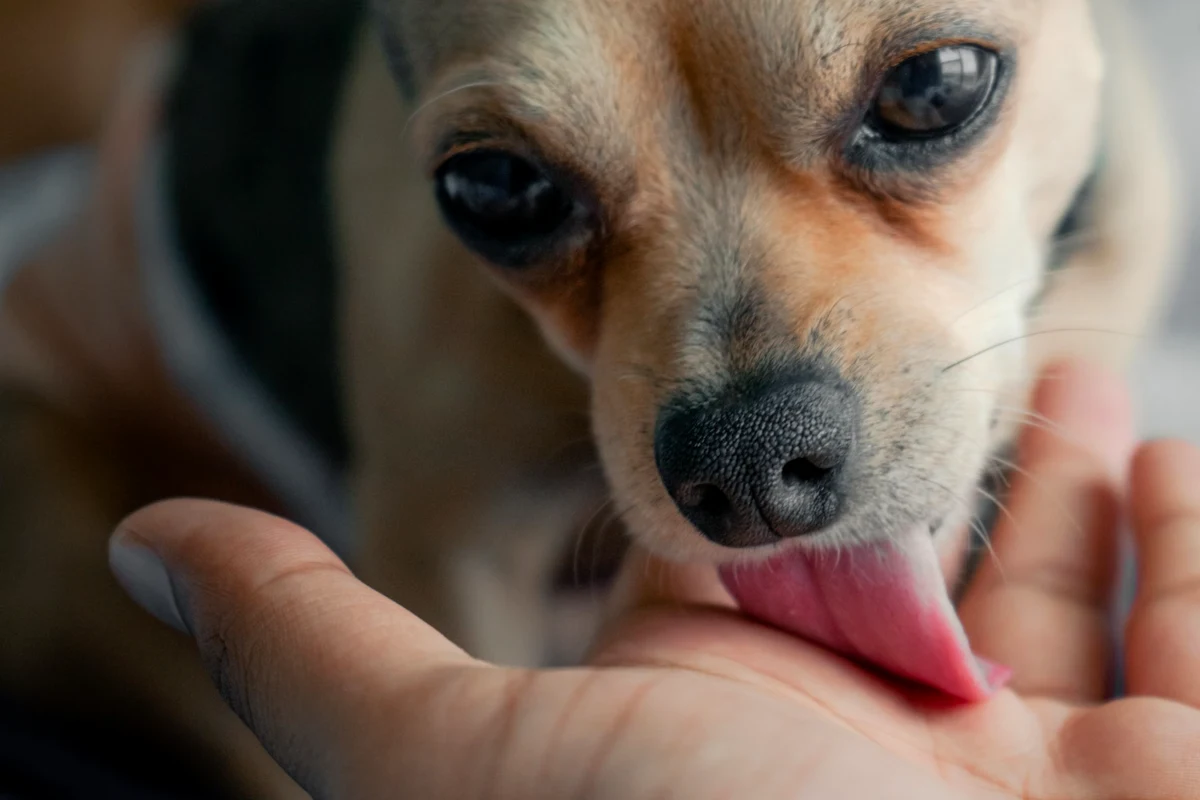
Why Do Dogs Lick You? A Quick Decoder
| The Lick | What It Usually Means | Try This Right Now |
|---|---|---|
| Your face the second you walk in the door | Inherited greeting behavior, the same muzzle lick wild canid puppies use on returning adults | Greet back calmly, then turn your face aside and offer a hand instead |
| Your hands and arms after a workout | Salt and sweat, not sentiment | Rinse off before couch time and the licking usually stops on its own |
| Your face right after you have eaten | Food residue, plus a very old request for a share of the meal | Wipe your mouth and hands before you sit down next to your dog |
| Slow, repetitive licking while lying against you | Self soothing, the canine version of a thumb suck | Leave it alone unless it runs for many minutes without stopping |
| Licking that starts the moment you look away | A learned attention grab that has worked before | Stand up and walk away without a word, every single time |
| Their own paws or legs rather than you | Itch, allergy, pain, or boredom | Call your vet, this is the one on the list that is not a social behavior |
The Five Real Reasons Dogs Lick People
1. It started as a request for food
This is the part most owners have never heard. Dr. Alexandra Horowitz, who runs the Dog Cognition Lab at Barnard College, points out that researchers studying wolves, coyotes, foxes and other wild dogs see puppies licking the face and muzzle of their mother when she returns to the den, specifically to get her to regurgitate food for them. So the enthusiastic face licking you get when you walk through the door is, in its original form, your dog asking you to throw up your lunch. The American Kennel Club covers this in detail, and it is worth knowing before you read too much romance into it.
2. You taste good
Certified applied animal behaviorist Dr. Mary Burch notes that human skin is slightly salty, and much saltier after you sweat. If your dog is suddenly very interested in your arms and legs after a run or on a hot afternoon, you are a salt lick with a pulse. Horowitz adds that face licking often spikes right after you finish a good meal, which is a strong hint that the flavor on your face matters more than the face itself.
3. It became a way of saying hello
Here is where the affectionate reading earns its place. Horowitz explains that although licking began as food seeking, it has since become a ritualized greeting for many dogs, and some wild species in the dog family lick pack members purely to welcome them home. The behavior outgrew its original job. Watch two dogs who like each other meet and you will see the same muzzle lick, aimed at a face that is never going to produce a meal.
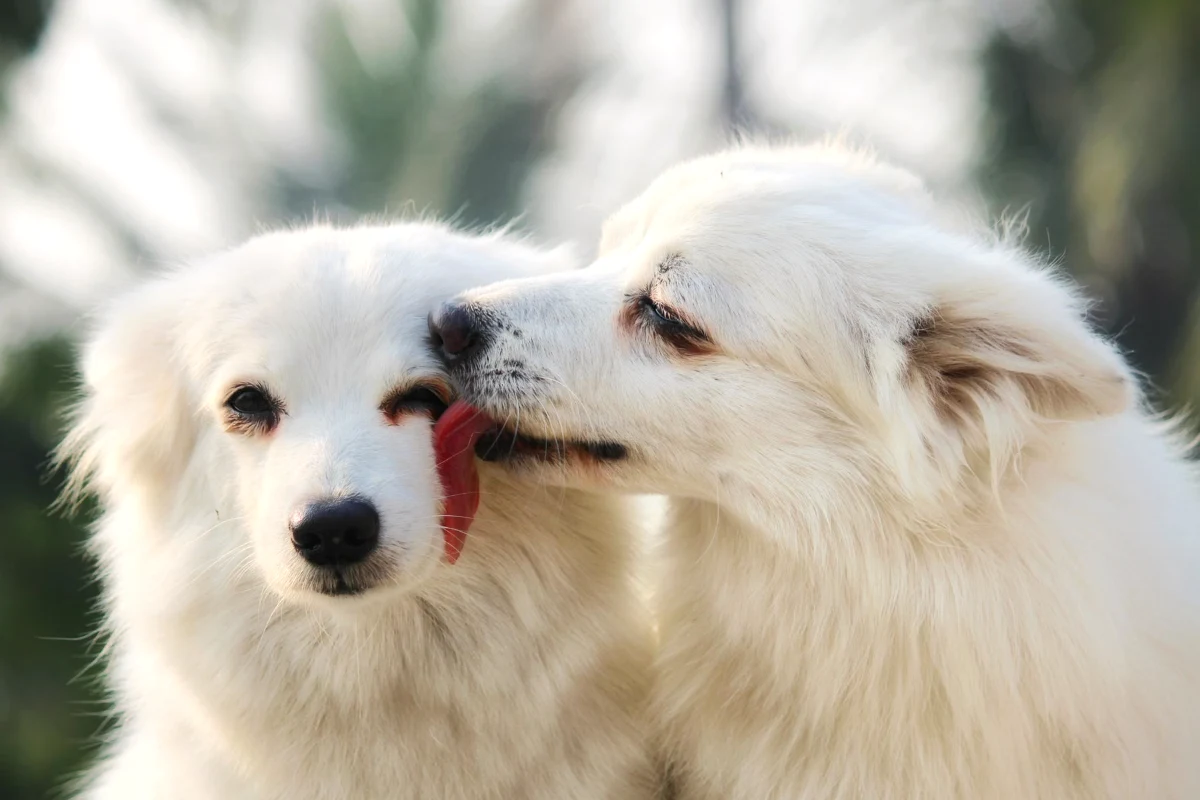
That is the same gesture your dog redirects at you. Burch adds that licking can also give a dog a feeling of security and comfort, the way being licked by their mother did in the litter.
RELATED: Bringing Home a Rescue Dog: Your First-Week Survival Guide
4. It calms them down
Licking is rhythmic and repetitive, and repetitive behaviors are self soothing. A dog who licks your hand slowly and steadily while settling in beside you is doing something closer to deep breathing than kissing. This is normal and harmless in small doses. It only becomes a concern when it is the dog’s main coping tool, which is covered further down.
5. It has always worked
The least romantic reason is often the strongest one. Your dog licks you, you laugh, you look down, you scratch their ears. That is a paycheck. Even pushing your dog away and saying no is attention, and for a bored dog attention of any kind beats being ignored. If the licking reliably starts the moment your attention drifts to your phone, you are almost certainly looking at a trained behavior rather than an emotional one.
So Is Licking Really a Dog Kiss?
Partly, and it is worth being honest about the rest. Dogs did not invent kissing and then teach it to us. They inherited a food-seeking gesture, kept it after it stopped serving that purpose, and now use it socially. When your dog licks you, they are doing something real and something friendly. They are not, as far as anyone can demonstrate, doing the thing you would be doing if you kissed them back.
One myth worth putting down: licking is not a dominance display. Burch notes it is closer to the opposite, and that one longstanding theory reads licking as a sign of submission, with less confident dogs licking higher ranking ones. Nobody needs to worry that accepting a lick undermines their authority.
RELATED: How Long Does It Take to Potty Train a Puppy? A Realistic Timeline
When Licking Stops Being Normal
Most licking is harmless self expression. The line to watch is whether the licking still looks social, or whether it has turned into something your dog does regardless of who is in the room. The AKC flags excessive licking of you, themselves, or objects as a possible sign of anxiety, boredom, or pain, and obsessive self licking as a possible sign of allergies.
Self licking is the version that does real damage. VCA describes lick granuloma, where repeated licking of the lower limbs damages the skin and the bone underneath. The cruel part is the loop: the licking inflames the area, and the inflammation makes the dog lick more. Underlying arthritis, an old fracture, or a skin disorder often starts it, and chronic stress or too little physical and mental enrichment keeps it going.
| What You See | Normal or Not | Your Next Step |
|---|---|---|
| A few licks as a greeting, then your dog moves on | Normal | Nothing at all, this is just how dogs say hello |
| More licking on hot days or right after exercise | Normal | Rinse the salt off your skin and watch it stop |
| Licking one spot on their own leg until the fur thins | Not normal | Book a vet visit, this is how a lick granuloma begins |
| Licking floors, walls, or furniture for long stretches | Not normal | Book a vet visit, surface licking can point to nausea or gut trouble |
| Licking you cannot interrupt with food or a favorite toy | Not normal | Vet first to rule out pain, then a behavior plan |
| Sudden new licking in a dog who never did it before | Not normal | Vet visit, an abrupt behavior change usually means discomfort |
Is It Safe to Let Your Dog Lick You?
For most healthy adults, a lick on the hand is a non event. It is still worth knowing the actual risk rather than guessing. The CDC notes that up to 74 percent of dogs carry Capnocytophaga canimorsus in their mouths, and that most people who have contact with a dog never get sick from it. The bacteria cause problems when saliva reaches an open wound or sore, or comes in through a bite.
The people who should be more careful are the ones with weakened immune systems, and the CDC singles out those without a functioning spleen as being at dramatically higher risk. A few practical rules that cost you nothing:
- Keep dog licks away from open cuts, scrapes, surgical sites, and fresh tattoos
- Skip the face and mouth, which is the least useful place for a lick anyway
- Wash your hands after a serious licking session, especially before eating
- If you are immunocompromised, pregnant, or missing a spleen, ask your own doctor where to draw the line
- Watch for fever, redness, or swelling in the days after a bite and get it looked at
None of that means you need to stop your dog from licking you. It means you get to make an informed choice about where.
How to Get Your Dog to Stop Licking You
If the licking is excessive rather than occasional, start with your veterinarian and rule out medical causes and discomfort before you treat it as a training problem. Once your dog has a clean bill of health, the approach that works is redirection rather than punishment.
Burch recommends switching the activity the moment the licking starts, and choosing something physically incompatible with licking. A dog working on a puzzle feeder cannot lick your arm at the same time. Repeat the swap consistently and you teach the lesson without a single correction.
- Redirect to a puzzle toy. Occupying the mouth is the whole point, so pick something that takes real work to solve
- Ask for a sit, then reward it. Sitting often ends the licking on its own, and now you are paying for the behavior you want
- Use a lick mat. Smear dog-safe peanut butter or plain yogurt on one and let your dog satisfy the urge somewhere harmless
- Teach a trick instead. Trick training turns a nuisance habit into a chance for positive reinforcement and burns mental energy
- Leave the room, silently. For attention-seeking licking, the only response that works is removing the reward entirely
- Add exercise. Excess energy has to go somewhere, and over-licking is one of the tamer places it can go
What does not work is scolding. Any reaction is still a reaction, and for a dog who is licking to get your attention, a sharp no is a partial win.
RELATED: Dog Weight Chart: Healthy Weight by Size and Breed
Frequently Asked Questions
Does my dog lick me because they love me?
Sometimes, and it is genuinely a friendly social gesture. But licking also serves as a greeting ritual, a taste-seeking behavior, a self-soothing habit, and a learned way to get your attention. Love is one plausible ingredient rather than the only explanation.
Why does my dog lick me so much at night?
Evenings are usually when you finally sit still, which makes you available. Settling-in licking also tends to be the calming, rhythmic kind. If it is keeping you awake, redirect to a lick mat or a chew before you sit down rather than after the licking starts.
Why does my dog lick my feet?
Feet concentrate sweat and salt, and they carry a dense record of everywhere you have been. For a nose that good, your feet are the most information-rich part of you. It is not an insult and it is not a compulsion, it is just where the flavor is.
Should I let my dog lick my face?
It is your call, but the face is the weakest spot to allow it. Mouth, eyes, and nose are direct routes for bacteria, and the face is also where a startled dog is most likely to make contact with teeth. Offering a hand instead gives your dog the same social exchange with none of the downside.
Is my dog licking me a sign of anxiety?
It can be. The tell is context. Anxious licking tends to be repetitive, hard to interrupt, and shows up alongside pacing, panting, or trembling. Social licking is brief, happens at predictable moments like greetings, and stops when your dog finds something better to do.
When should I take my dog to the vet for licking?
Go if your dog is licking one spot on their own body until the fur thins or the skin breaks, licking surfaces around the house for long stretches, licking in a way you cannot interrupt, or has suddenly started licking after a lifetime of not doing it. All four are more likely to be medical than behavioral.
The Bottom Line
Your dog licks you because their ancestors licked for food, because you taste faintly of salt, because the gesture turned into a greeting somewhere along the way, and because it has reliably gotten your attention for as long as they have known you. Take the affection reading if you like it, just keep an eye on the version that has stopped being social. A dog licking you is normal. A dog who cannot stop licking is telling you something else.
Author

Shopping for your pet on Amazon? New members can sign up for a free trial of Prime for fast free shipping and member-only deals, and cancel anytime.
Sign Up for a Free Trial of Prime