


PRIME BIG DEAL DAYS IS OCTOBER 6 TO 7
Prime members get the sale prices, plus fast free shipping on food, litter, and pet gear. New to Prime? Try it free.
Start Your Free Prime TrialThe best cat litter box for most homes is the Powools 808 Stainless Steel High-Sided Box at $34.99, because it gets the two things right that almost every listing buries: a genuinely deep pan and a wide open top your cat can turn around in. Everything else on a spec sheet is decoration.
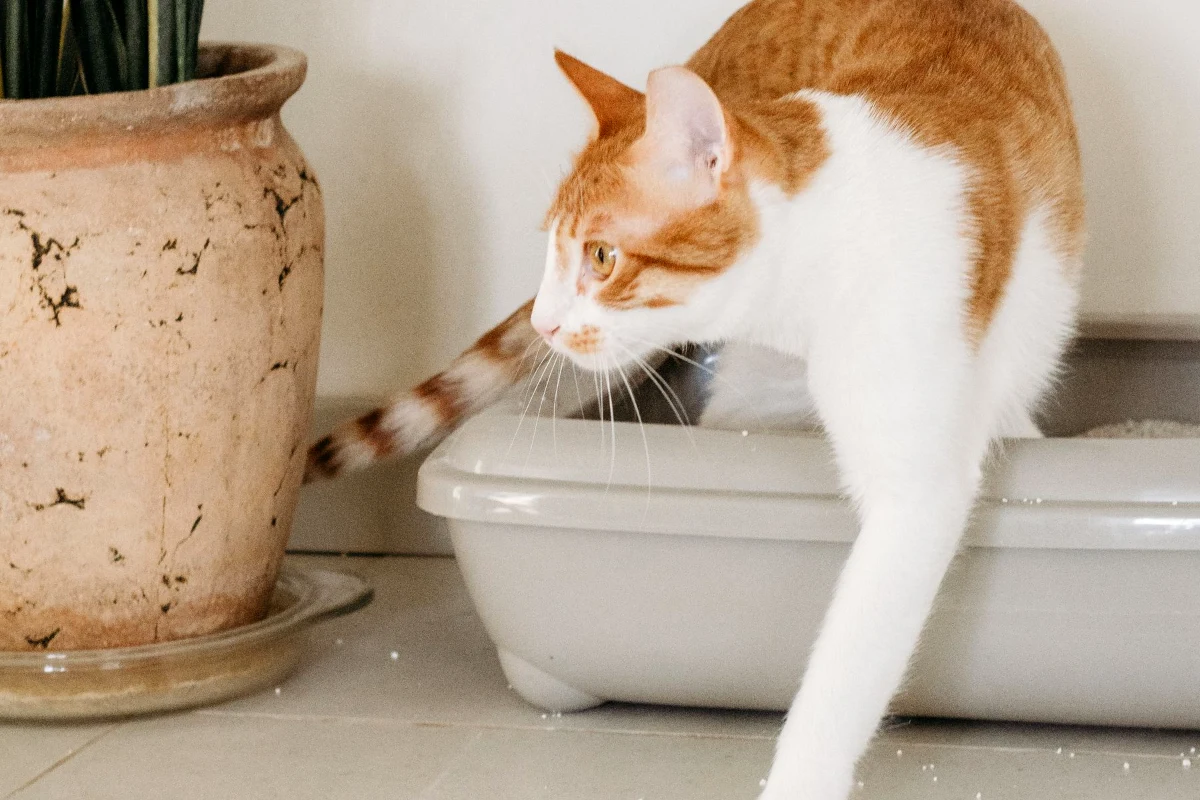
Here is the part nobody selling you a litter box wants to lead with. Cornell’s Feline Health Center reports that most cats prefer uncovered boxes that are large but have low sides, and that you should keep one box per cat plus one. Most of what is for sale right now is covered, hooded, or hidden inside furniture. So this list is built around interior space first, and the lid is treated as the compromise it actually is.

| Pick | Price | Best for | Buy it if |
|---|---|---|---|
| Powools 808 Stainless | $34.99 | Overall | You want the most usable floor space per dollar and do not need a lid |
| labeta 4-in-1 Stainless | $59.99 | Large or multi-cat homes | Your cat is big, or two cats share one box and you need the 38L capacity |
| PWTAA Stainless Set | $79.99 | A complete setup | You are starting from zero and want box, mat, and scoop in one order |
| Cielozen Hidden Enclosure | $98.79 | Hiding the box | The box lives in a room guests see and you already own a pan you like |
| Himix Open Top Automatic | $119.99 | Skipping the daily scoop | You travel, work long days, or physically cannot scoop every day |
The 5 Best Cat Litter Boxes
1. Powools 808 Stainless Steel High-Sided Box, $34.99 (Best Overall)

Stainless steel with a 6-inch splash-proof deep pan, high sides, and a scoop included. It is the cheapest pick here and it is also the one that best matches what the veterinary guidance actually asks for: a large open area with nothing over the top of it. Steel does not scratch into the micro-grooves that hold odor the way plastic does after a year of scooping, which is the real reason old plastic boxes start to smell no matter how often you clean them.
- 6-inch deep pan, so litter stays in when your cat digs hard
- Open top with no lid to remove, wash, or fight with
- Stainless steel, non-stick and non-porous
- Metal scoop included
- 4.5 stars across 1,154 ratings, by far the most reviewed box on this list
The trade-off: this is the M size, and M is not large. If you have a Maine Coon, a Ragdoll, or any cat over about 18 inches from nose to tail base, measure before you order. Steel is also cold underfoot in an unheated basement or garage, which some cats visibly dislike in winter.
RELATED: The 3-3-3 Rule for Cats: What to Expect the First 3 Months
2. labeta 4-in-1 Stainless Steel with Flip Lid, $59.99 (Best for Large or Multi-Cat Homes)
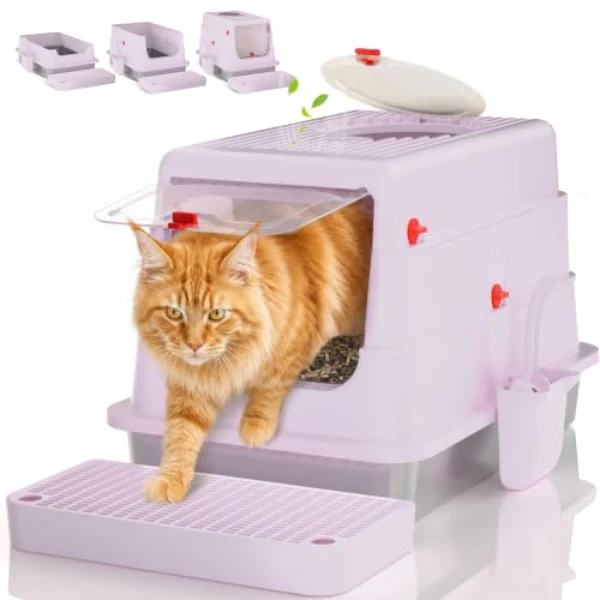
38 liters of capacity with high anti-leakage sides and a lid that flips back 160 degrees instead of lifting off. If you have a big cat or two cats sharing a space, capacity is the spec that stops you scooping twice a day, and this is the largest box in the roundup by a wide margin.
- 38L capacity, the most interior volume here
- 160-degree flip lid, so you are not looking for somewhere to set a wet lid down
- High sides sized against urine leakage, not just litter scatter
- Stainless steel body
- 4.5 stars across 107 ratings
The trade-off: the flip lid is the exact feature the Cornell guidance argues against, since most cats prefer no cover at all. The honest way to buy this box is to run it with the lid open for the first two weeks and watch whether your cat uses it fully. If your cat is happier that way, you paid $59.99 for a very good open pan and switched off the headline feature.
3. PWTAA Stainless Steel Box with Lid, Mat, and Scoop, $79.99 (Best Complete Setup)
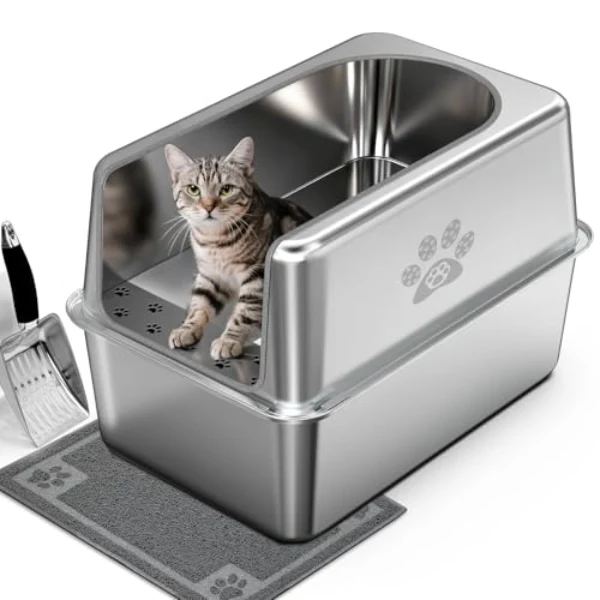
A leak-proof stainless box that ships with the litter mat and the scoop, which matters more than it sounds. The mat is the single cheapest fix for litter tracking through the house, and it is the accessory people put off buying for months while quietly sweeping every day.
- Stainless steel, leak-proof seams
- Litter mat included, which catches most of the tracking at the exit
- Scoop included
- Removable lid, so you can run it open or closed
- 4.5 stars across 24 ratings
The trade-off: 24 ratings is a thin sample, so treat the durability claims as the manufacturer’s rather than as verified by a large group of owners. You are also paying $45 more than the Powools for a mat and a scoop that cost far less bought separately. Buy this one for the convenience of a single order, not because it is the better box.
RELATED: Litter-Robot Alternatives: 6 Cheaper Self-Cleaning Litter Boxes
4. Cielozen White Large Hidden Litter Box Enclosure, $98.79 (Best for Hiding the Box)
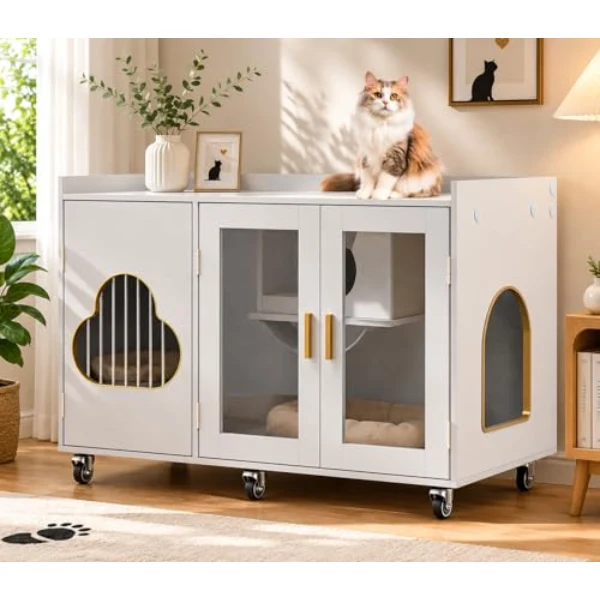
This is furniture, not a litter box. It is a white end table with glass doors and a partitioned interior that swallows a standard pan and reads as a piece of storage instead of a bathroom. If the only place your box fits is a living room or a hallway, this is the category that solves it.
- Fits most standard litter box pans
- Partitioned interior, so litter and storage stay separate
- Glass front doors with a cat-sized side entry
- Doubles as an end table
- 3.5 stars across 14 ratings
The trade-off: two real problems. First, you still have to buy the pan, so the true cost is $98.79 plus a box. Second, and more important, enclosing a pan recreates every issue VCA flags with covered boxes: a covered pan can let another cat ambush yours on the way out, and it traps odor that infrequent cleaning would otherwise let escape. This is also the lowest rated product here at 3.5 stars. Buy it for your room, and then scoop it twice as diligently as you would an open pan.
5. Himix Open Top Automatic Self-Cleaning Box, $119.99 (Best Automatic)
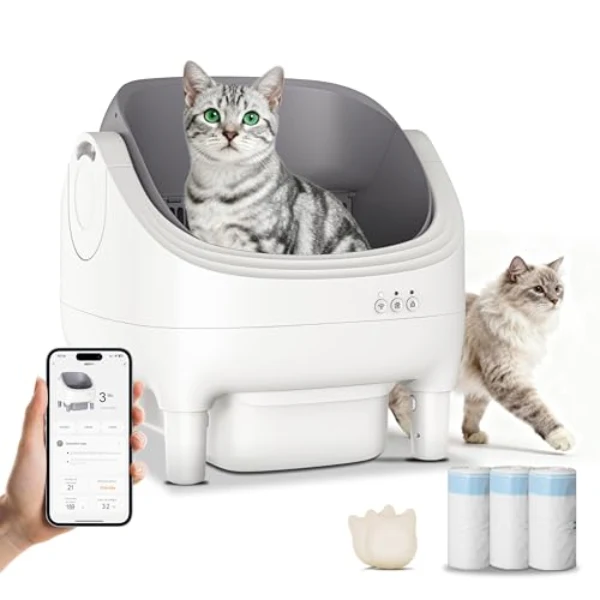
Most self-cleaning boxes are enclosed drums, which is the worst possible shape if your cat dislikes covers. This one rakes an open-top pan instead and reports to a phone app, so you get the labor saving without asking your cat to walk into a tunnel.
- Open top rather than an enclosed drum
- App control with cleaning history and waste-level alerts
- Automatic cycle after each use
- Works with standard clumping litter
- 4 stars across 28 ratings
The trade-off: it costs 3.4 times the Powools, and 28 ratings is very thin evidence for a product with a motor, a rake, and a sensor that all have to keep working for years. Skip it unless the specific thing you are buying is your daily scooping time back. If you want the automatic route with more owner history behind it, our roundup of cheaper self-cleaning boxes above is the better starting point.
What Makes a Litter Box Right for Your Cat
The number printed on the box is almost always the wrong number. Listings lead with capacity in liters or the exterior footprint, because those numbers sound generous and cost nothing to inflate. The spec that decides whether your cat actually uses the box is the interior floor length compared to your cat’s body length, and it is rarely in the bullet points.
The working rule is that the pan should be about one and a half times your cat’s body length measured from the nose to the base of the tail, so the cat can turn a full circle and dig without standing in yesterday. Measure your cat first, then shop.
| Your cat | Minimum interior length | Test it by |
|---|---|---|
| Kitten or small adult, under 14 inches | About 21 inches | Checking the entry rim is under 3 inches tall, or a kitten will skip it and go beside it |
| Average adult, 15 to 18 inches | 23 to 27 inches | Setting the empty pan beside your standing cat; it should be clearly longer than the cat |
| Large breed, 19 to 22 inches | 28 to 33 inches | Watching them squat; if the back end hangs over the rim, the box is too short |
| Senior or arthritic, any size | Same as their size class | Lowering one side to under 4 inches so they step in rather than climb in |
After length, the order of what matters is short. Cornell’s guidance is that cats want fine-textured unscented clumping litter, a large box with low sides, and no plastic liner. VCA adds that cats want at least 3 inches of digging material and a quiet, easy to reach location. Notice that colour, shape, odor filters, and app connectivity appear nowhere on either list.
RELATED: Overweight Cat? How to Tell and How to Help Them Slim Down Safely
One more sizing note worth planning around: an overweight cat can stop fitting comfortably in a covered pan they used for years, and VCA lists exactly that change in body condition as a reason to take the cover off. If your cat has gained weight, the box that suddenly gets avoided may not have changed at all.
When a Litter Box Problem Is Actually a Medical Problem
Before you buy anything, rule this out. A cat that suddenly stops using a box it has used for years is giving you a symptom, not an opinion about the box. House soiling that starts abruptly warrants a veterinary exam first, because urinary tract disease, bladder stones, arthritis, and kidney problems all present as litter box avoidance.
Treat these as urgent, especially in male cats, where a urethral blockage can become life threatening within a day:
- Straining in the box and producing little or nothing
- Going in and out of the box repeatedly over a short period
- Blood in the urine
- Crying or vocalizing in the box
- Licking at the genital area much more than usual
No box on this page fixes any of that. Call your vet, then come back and pick a box.
Frequently Asked Questions
How many litter boxes do I need?
One per cat plus one. Cornell recommends that count specifically to cut competition, so two cats means three boxes, placed in different rooms rather than lined up together in one corner. Boxes in a row read to a cat as one location.
Do cats prefer covered or uncovered litter boxes?
Most prefer uncovered. That is Cornell’s finding, and it is the opposite of how the market is stocked. If you are unsure about your own cat, VCA suggests putting a covered and an open box side by side with the same litter and letting the cat vote over one to two weeks.
How deep should the litter be?
At least 3 inches, deep enough for a full dig and cover. Shallow litter is one of the most common reasons a perfectly good box gets abandoned, and it costs nothing to fix.
Is stainless steel really better than plastic?
For longevity, yes. Plastic develops fine scratches from scooping and from claws, and those grooves hold urine residue that no amount of surface cleaning reaches, which is why a two-year-old plastic box smells even right after it is emptied. Steel does not scratch that way. Plastic is still perfectly fine if you replace the pan every year or two.
Where should I put the litter box?
Somewhere quiet, easy to reach, and away from food, water, and loud appliances. For a senior cat, put one on every floor of the house; a flight of stairs is a real barrier to an arthritic cat, and the accident on the landing is a mobility problem rather than a behavior problem.
How often should I scoop?
Once a day at minimum, twice if you have more than one cat or a covered box. Covered and enclosed designs hide the mess from you, not from your cat, so they need more attention rather than less.
RELATED: Best Cat Water Fountain: 6 Picks for Cats That Barely Drink
The Bottom Line
Buy the Powools 808 at $34.99 unless you have a specific reason not to. It is the cheapest option here, it has more owner reviews than the other four combined, and its open high-sided shape is the one the veterinary guidance actually supports. Step up to the labeta 38L at $59.99 if your cat is large or two cats share a box, take the Cielozen enclosure at $98.79 only if the box has to live somewhere guests can see, and take the Himix automatic at $119.99 only if what you are really buying is your scooping time back.
Then measure your cat, fill the pan 3 inches deep with unscented clumping litter, leave the lid off for two weeks, and see what happens. Most litter box problems are solved by size, depth, and location long before they are solved by a purchase.
Disclaimer: Some of the links in this article are affiliate links, meaning we may earn a small commission if you make a purchase through them. This comes at no additional cost to you and helps support Pawfect Journey. Thank you for helping us keep the journey going!
Author

Shopping for your pet on Amazon? New members can sign up for a free trial of Prime for fast free shipping and member-only deals, and cancel anytime.
Sign Up for a Free Trial of Prime


